Track the effective step size when training language models
Why can one training plan give different results for two ways of handling model weights? Weights are numbers a model changes as it…
ISSUE 29/2026 · 30-10-2026
How can one model answer different questions about a place it saw over time? The authors trained a model on questions requiring a choice, a measurement, or a time. They kept each answer in its original form. They also linked it to the observations available when the…

3 paper · Original sources linked in every story
5 MINUTES ON PtoP
Imagine a question about when a tax payment is due. An AI search tool might put an answer above the website links, making the answer easier to see than the page it came from. UK Government Communications has issued guidance on keeping public answers accurate in AI search results. Its point is a practical one: clear, current public pages still matter when people may never visit them. The guidance calls its advice a starting point, not a fixed set of rules. See: Strengthening public trust in the age of AI-powered search…
The same dependence on what lies behind an answer appears in research on video. The authors of ChronoReplay trained a model to answer questions about indoor scenes while keeping each answer tied to the observations available when the question was asked. They report raising its OST-Bench score from 50.52 to 63.93 against the official Qwen3-VL-8B base model under matched, scene-disjoint testing. But they also found that changing which frames the trained model could see improved a separate benchmark score. Better access to the record, not just better training, can change an answer. See: Ordered video histories may help AI answer different…
For images containing words, the issue is whether the output preserves what a person needs to read. Authors testing a fast image model added a check that compares patterns across generated and reference images. With two passes through IDM (Z-Image), they report a 90.20% English-text score on LongText-Bench, the highest among methods compared at that budget. That is a test score, not evidence that a draft would be ready to use at work. Even a quick-looking result can rest on careful checks during training. See: An Added Image Check May Help Fast Models Render Long Text
Sometimes the work behind an answer changes without replacing the whole system. IBM says it updated Granite Switch’s speech and decision features while leaving its base model unchanged. It says the updated speech-to-text model turns speech into writing across 10 languages, and reports better results for a decision-task add-on, though it gives no scores for that decision test. Taken alongside the search guidance, this suggests a useful way to think about AI tools: what you receive may depend on the source material and the particular skill being refreshed, not only on the main model. See: Granite Switch 4.1.1 — Update models like you update… · Strengthening public trust in the age of AI-powered search…
That does not mean we must inspect every hidden step. It does suggest a small habit when an answer matters: notice what kind of source or record the tool could be drawing on, and whether it is current. This week, could you try checking one AI search answer about a public service against the current public page, and see whether the wording still matches? See: Strengthening public trust in the age of AI-powered search…
Just here for the stories? They are below, by topic.
PtoP · NEWSLETTER
Six papers and the news, explained in plain English, each morning after the editor approves the issue. Free, and you can unsubscribe at any time.
News and analysis from the sources, separate from the papers. Headlines and dates link to the originals.
THIS ISSUE AT A GLANCE
 ↗02 / NEW / EDITOR PICKSAn Added Image Check May Help Fast Models Render Long TextCan a fast image maker keep long text clear with little time to refine it? The authors trained it to…
 ↗03 / TOP VOTED · 6 MONTHSOrdered video histories may help AI answer different spatial questionsHow can one model answer different questions about a place it saw over time? The authors trained a model…↗
PODCAST / ENGLISH EDITION
The front-page episode covers the papers and news; each paper also has its own short conversation.
Both voices are AI-generated with OpenAI. This is a scripted editorial conversation, not a recording of the authors.
Why can one training plan give different results for two ways of handling model weights? Weights are numbers a model changes as it…
Can a fast image maker keep long text clear with little time to refine it? The authors trained it to compare generated images with…
How can one model answer different questions about a place it saw over time? The authors trained a model on questions requiring a…
FROM THE NEWS DESK
Editorial explanations of the sources: examples and possible uses are distinguished from what the source establishes.
People and society Government Communications · 20-10-2026 · updated 29-10-2026 · government or regulator
UK Government Communications has issued guidance on keeping public answers accurate in AI search results. Picture someone asking when a tax payment is due and seeing an answer above website links. This is AI search: software writes an answer instead of only listing websites.
For example, someone might trust a search answer that gives an outdated tax payment deadline.
The guidance calls its advice a starting point, not a fixed set of rules.
Clear, current public pages matter when search tools answer questions without sending people to those pages.
The guidance says people may get answers without clicking through to government websites. It cites reports on changing search habits and warns that outdated pages could spread wrong information. Government communications, policy, and website teams are asked to work together on public content. Its PRIME plan has five steps: plan, respond, make changes, check results, and assess progress. The guidance says dependable ways to measure success are still being developed.
A government team could update an old deadline page, then check how search tools present it.
Was this explanation easy to understand?
Business and strategy BBC News · 29-10-2026 · news report
The BBC reports Microsoft made more than $36.6bn in quarterly profit. That means money left after costs over three months; bn means billion. Microsoft said it would offer payments to around 60,000 workers to leave. The BBC does not say those workers have left.
A shop might sell more goods while buying costly new machines. It could also offer staff money to leave, hoping to lower future costs.
The BBC says it remains unclear whether Microsoft's heavy AI spending will pay off. Its report does not say how many workers will accept the offers.
The BBC reports strong profits alongside Microsoft's announcement that it would offer workers payments to leave. Those offers are not completed job cuts.
Imagine a shop earning more money while offering some staff payment to leave. The BBC says Microsoft wants to cut costs while spending billions on AI. AI means computer tools that learn patterns and produce answers. Microsoft said it would offer buyouts, or payments for workers who choose to leave. The offers would cover eligible workers in Canada, India, the UK, and US. The BBC says cloud services, or online computing services, helped raise Microsoft's sales. Investors are watching Microsoft's spending, but whether that spending will pay off remains unclear.
A worker offered a buyout could weigh its financial support against the risks of leaving.
Was this explanation easy to understand?
Tools and building Hugging Face Blog · 29-10-2026 · company announcement
IBM says it updated Granite Switch’s speech and decision features without changing its base model, the main AI system. Imagine spoken meeting notes appearing in writing with capital letters and punctuation already added. IBM says its updated speech-to-text model turns speech into writing across 10 languages. IBM also reports better results for its Decision adapter, a small add-on for decision tasks.
A shop could turn a spoken customer request into readable text for a worker to review.
IBM reports better results on the Jev Decision Index, a decision test, but gives no scores.
IBM presents this as a way to refresh focused AI skills without changing its main system.
IBM released Granite Switch 4.1 just over a week before this smaller update. That version let users add focused skills through adapters, or small AI add-ons. IBM says users do not need to move their work from version 4.1. It says the base model, the main AI system, remained unchanged for this release. IBM plans guides and tools for outside developers, but gives no arrival date.
A team could update its speech feature while keeping the main AI system unchanged.
Was this explanation easy to understand?
ENGLISH EDITION / PAPER 01 · NEW / EDITOR PICKS
Why it matters to youA training plan can look steady even when its actual effect changes. The authors’ experiments suggest tracking the effective step size could help researchers choose training plans.
Why can one training plan give different results for two ways of handling model weights? Weights are numbers a model changes as it learns. The authors compared weights kept at a fixed size with weights whose sizes could change. They tracked the effective learning rate, meaning the planned step size divided by a weight group’s size. When they matched this rate across methods, their training loss paths largely matched. Training loss measures how poorly a model predicts its training text. They then designed AIR, a plan that lowers step size along a modified inverse-square-root curve. This curve drops quickly at first, then more slowly.
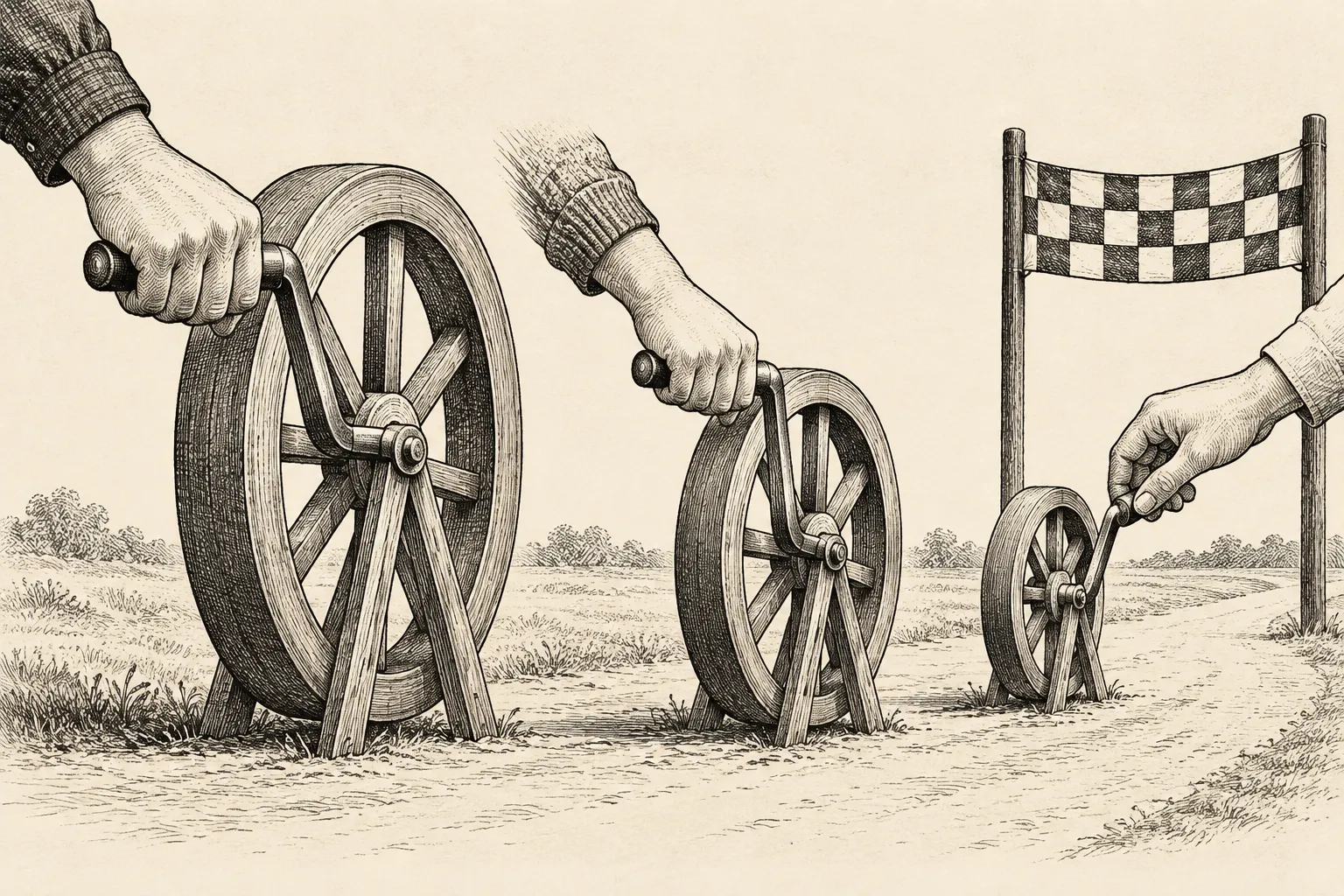
Hypothetical illustration: two people turn equally long handles attached to wheels of different sizes. The same hand movement turns each wheel by a different amount. The authors use a similar comparison to explain why planned updates may change weight direction differently.
The authors’ summaries describe individual training runs, not averages across runs with independent random starting settings. Their theory assumes simplified updates with stable properties. They leave a measured link between its alignment measure and loss for future work. That measure tracks how closely weight directions match a target direction. Some experiments replacing parts of a training plan do not keep the total planned learning rate fixed. The authors also leave other model designs, training methods, larger scales, and later training stages for future study. PtoP note: this source is a preprint, and its training comparisons are not deployment tests.
In the authors’ fixed-size-weight model trained on 128B tokens, AIR’s final training loss was 1.730. Cosine’s was 1.740; cosine is another plan for lowering step size. Training loss measures how poorly the model predicts training text, so lower is better. The comparison kept both the sum of planned learning rates and the ending rate fixed. A learning rate is the planned step size. The authors also report lower final training loss and evaluation loss for AIR at their larger model scale. Evaluation loss measures how poorly the model predicts text used to check its performance.
The authors found that matching effective learning rates largely matched training loss paths across both methods. An effective learning rate is the planned step size divided by a weight group’s size. Their experiments swapping parts of training plans also point to the late stage as important for final-loss differences. These findings come from the reported training comparisons, not tests of a rule for every model.
For teams already training language models, the paper offers a way to compare plans by effective step size. The authors tested AIR during initial training of their mixture-of-experts models. These models use selected parts for each input. They did not report tests in continued training or fine-tuning, which is further training for a task.
FROM PAPER TO PRACTICE
Conceptual exercise only: the supplied paper provides no verified installation procedure or official code repository. No software or paid access is needed for these steps.
An n8n workflow is not appropriate here: the paper studies model training schedules, not a tested automation integration.
Was this explanation easy to understand?
ENGLISH EDITION / PAPER 02 · NEW / EDITOR PICKS
Why it matters to youImages made from written instructions can miss small words, especially when made in few steps. The authors report a training change that improved long-text scores for one fast image model.
Can a fast image maker keep long text clear with little time to refine it? The authors trained it to compare generated images with reference images, which are target examples. They also checked image summaries, or numbers the model extracts from each image. The added check compares the average and spread of those numbers across images. It works beside a broader comparison that guides each generated image.
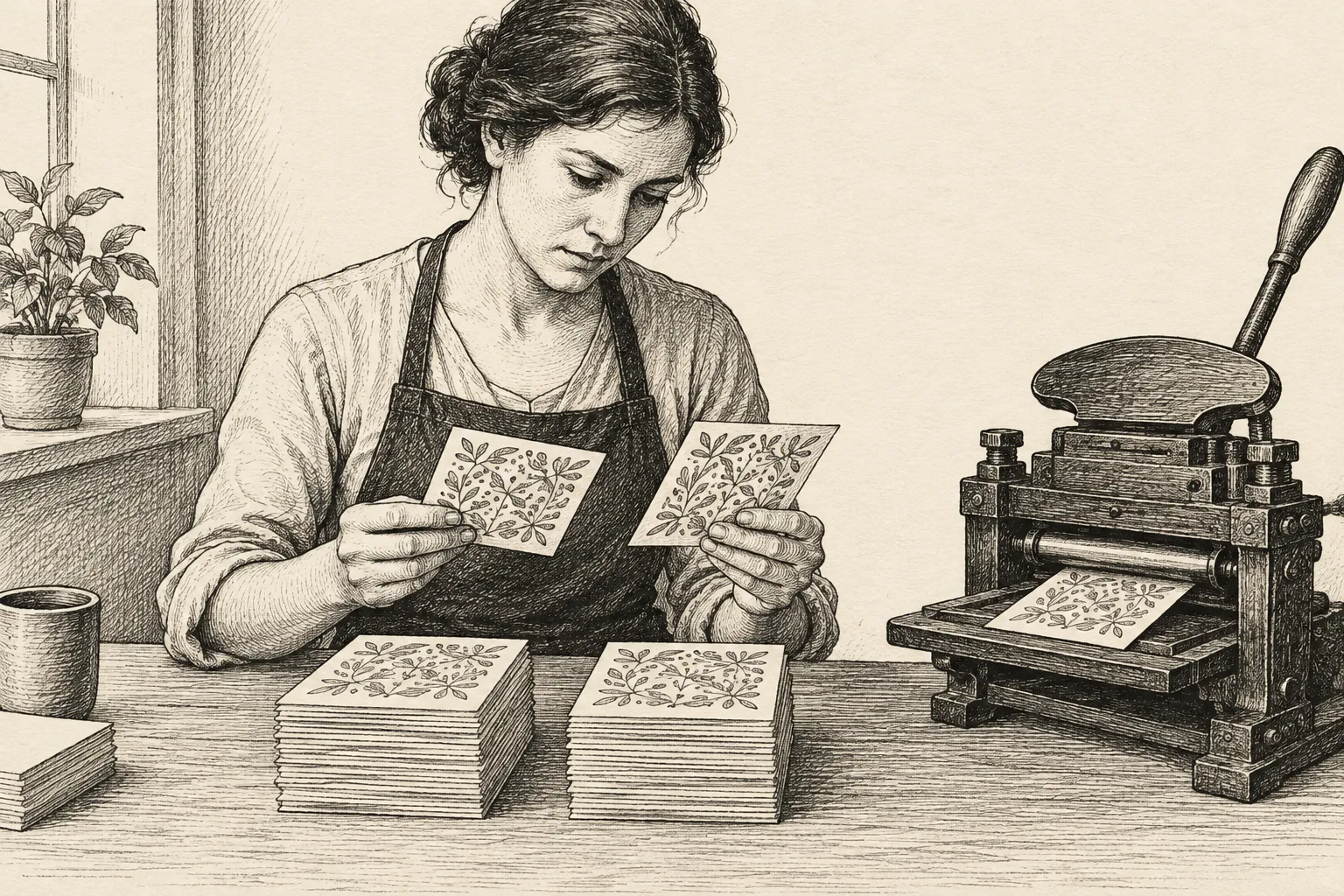
Hypothetically, a designer asks for a café poster with several drink names. The model makes posters, and training compares them with reference images, which are target examples. The added check compares averages and spreads across image summaries, or numbers extracted from images. It does not check whether every word on each poster is correct.
The added check combines image summaries across prompts, rather than matching results for each prompt separately. Its saved summaries come from earlier training states, so they only approximate current averages and spreads. The authors say averages and spreads cannot capture every difference between image groups. Published APEX comparisons also use different training data. They therefore compare whole training setups rather than isolating this check. PtoP note: this is an arXiv preprint, a paper shared before journal publication. Benchmark scores are not a workplace deployment.
LongText-Bench is a test of how well images show long passages of text. At two model passes, or runs through the model, the authors report 94.25% for Chinese text with IDM (Z-Image). They report 90.20% for English text with the same model and setting. These were the highest scores among the methods compared at that budget. In a shared full-tuning test, which updated all model settings, adding the average-and-spread check improved all five reported overall measures. That improvement was over the version without the check.
The authors test whether a group-level check helps when each image has few chances for correction. Their controlled comparison tests the added check within the same training setup. It does not show how the method performs in a design or publishing job.
A possible use is training fast image tools for drafts containing dense text. The paper reports tests of image models, not a tool used in a workplace.
FROM PAPER TO PRACTICE
Installation is unverified because the supplied text gives no usable code or model link.
An n8n workflow is not appropriate here because the paper tests model training, not a verified workflow feature.
Was this explanation easy to understand?
ENGLISH EDITION / PAPER 03 · TOP VOTED · 6 MONTHS
Why it matters to youA video assistant might need to remember where something was or how far away it was. It might also need to remember when something appeared. This research explores whether training on ordered histories could help one model answer all three kinds of questions.
How can one model answer different questions about a place it saw over time? The authors trained a model on questions requiring a choice, a measurement, or a time. They kept each answer in its original form. They also linked it to the observations available when the question was asked. Finally, they controlled how strongly each group of training examples shaped the model.
Hypothetical illustration: someone walks past a plant, turns, and later asks when the plant appeared. They might also ask whether it was left of their earlier path. The answers depend on different parts of the same walk. This is not a reported test of a walking assistant.
The authors tested indoor scenes; other environments remain untested. OST training used released OST data. Its evaluation used different scenes and withheld ScanNet scenes that overlapped with training. The headline scores use one training seed, or one starting point for training randomness. Some training choices, however, have repeated comparisons. The authors report a selected room-layout question that ChronoReplay answered incorrectly and the base model answered correctly. They do not claim it is suitable for surveillance, autonomous navigation, or other safety-critical use. PtoP note: this source is an arXiv preprint, a paper shared before confirmed peer review. It is not evidence of peer review or a tested deployment.
The authors report that ChronoReplay raised the OST-Bench score from 50.52 to 63.93. They compared it with the official Qwen3-VL-8B base model using matched, scene-disjoint evaluation. That means they used matching test conditions and kept test scenes separate from training scenes. The score combines the benchmark’s question types, including estimates and time-related answers. A benchmark is a set of test questions; this score does not count only correct distance answers. They also report gains on OVO-S-Bench and UCS-Bench while holding observation access fixed. Observation access means which video frames the model could see. Separately, changing the frames shown to the same trained ChronoReplay model improved its OVO-S-Bench score. That improvement came from access to different frames, not another training gain.
A system trained mainly to choose left or right may lack detail needed to estimate distance. The authors report uneven results when they trained separate versions on different question groups. Their combined training addresses that pattern without adding a new memory component.
Possible applications include assistants that answer questions about recorded indoor tours. The paper tests benchmark questions, not an assistant working in a home or workplace.
FROM PAPER TO PRACTICE
The official repository provides a CPU-only software example; it does not reproduce the paper’s scores. Installation and execution are unverified here. Prerequisites are Git, Python 3.11, a computer able to install the listed packages, and access to download them; package or compute costs may apply. No model download is needed for this example.
An n8n workflow is not appropriate here: the paper evaluates model training and benchmark scoring, not a tested connection to this workflow tool.
Was this explanation easy to understand?
COMPARISON
Compare topics, possible uses and limits. Each result remains attributed to its own paper.
| Paper | Central idea | Possible use | Limit |
|---|---|---|---|
| Track the effective step size when training language models | Why can one training plan give different results for two ways of handling model weights? Weights are numbers a model changes as it learns. The authors compared weights… | For teams already training language models, the paper offers a way to compare plans by effective step size. The authors tested AIR during… | The authors’ summaries describe individual training runs, not averages across runs with independent random starting settings. Their theory… |
| An Added Image Check May Help Fast Models Render Long Text | Can a fast image maker keep long text clear with little time to refine it? The authors trained it to compare generated images with reference images, which are target… | A possible use is training fast image tools for drafts containing dense text. The paper reports tests of image models, not a tool used in a… | The added check combines image summaries across prompts, rather than matching results for each prompt separately. Its saved summaries come… |
| Ordered video histories may help AI answer different spatial questions | How can one model answer different questions about a place it saw over time? The authors trained a model on questions requiring a choice, a measurement, or a time. They… | Possible applications include assistants that answer questions about recorded indoor tours. The paper tests benchmark questions, not an… | The authors tested indoor scenes; other environments remain untested. OST training used released OST data. Its evaluation used different… |
ARCHIVE
The last two issues. Every earlier edition is in the archive.
29