Robot Instructions Could Improve by Learning From Failed Attempts
Can a robot use one attempt to guide its next attempt? The authors built Embodied-Harness, a system that separates doing a task from…
ISSUE 44/2026 · 24-11-2026
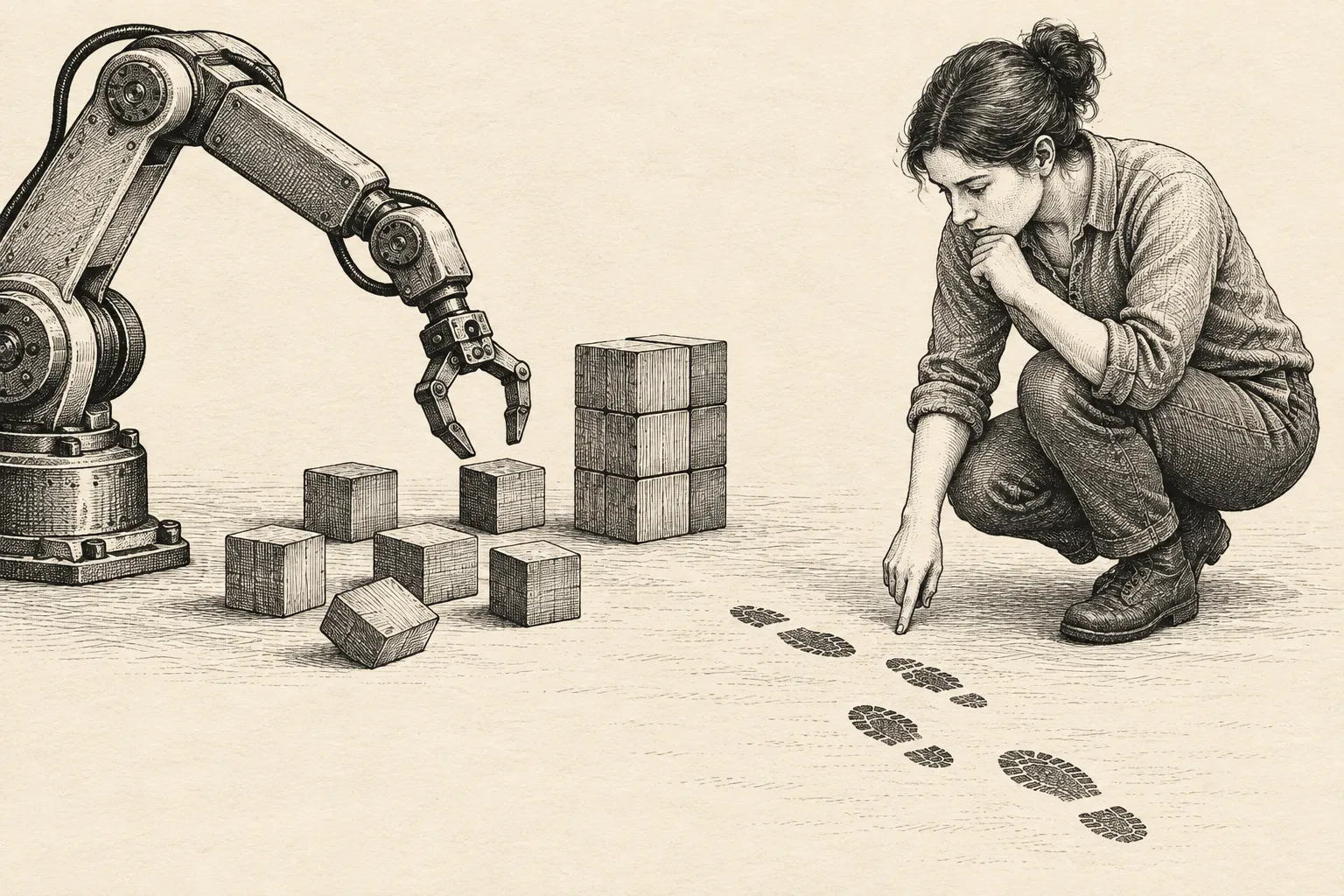
Can a robot use one attempt to guide its next attempt? The authors built Embodied-Harness, a system that separates doing a task from reviewing it. An Actor controls the robot. A Reflector reviews recorded actions and outcomes. The Reflector revises the harness, or…
3 paper · Original sources linked in every story
5 MINUTES ON PtoP
One thread runs through today’s items: what happens after an AI system starts a job and conditions change? The authors of Embodied-Harness study how a robot can revise its instructions after an attempt. The authors of Motion Mamba 2.0 study how a humanoid can keep moving when given a new direction. In another setting, OpenAI says a tool it introduced with Cisco aims to protect running computers while teams prepare permanent fixes. None is a promise that the first plan will be right; each makes room for a next step. See: Robot Instructions Could Improve by Learning From Failed… · Motion software could help humanoids follow changing… · OpenAI and Cisco introduce Shirudo
In Embodied-Harness, an Actor controls the robot while a Reflector reviews recorded actions and outcomes, then changes instructions for later attempts without changing the underlying models. The authors report 82.4% task success in a RoboTwin 2.0 setting with randomized conditions, and 96.7% average success across three tasks using a physical Piper arm. Those are results from named tests, not a measure of workplace reliability. Still, the design suggests a useful question for any repeated task: what should be remembered from an unsuccessful attempt? See: Robot Instructions Could Improve by Learning From Failed…
Motion Mamba 2.0 takes a different approach to adjustment. Its authors generate movement in short, successive sections, using recent motion and a compact memory of earlier accepted movement. Across four physical G1 tasks, they report that the complete system finished 94 of 100 trials without a fall, protective stop or human intervention. They also say it does not yet address object manipulation. A robot changing its path, then, is not the same as a robot able to handle whatever it finds there. See: Motion software could help humanoids follow changing…
The same distinction matters away from robots. OpenAI says a controlled test of Shirudo blocked an attack while a search service kept running. The company also says teams must check whether a proposed shield interferes with normal requests; the controlled result does not establish wider effectiveness. Meanwhile, MIT Technology Review reports that AI models tested by METR did worse on judgment tasks, including scoring arguments, than on coding tasks. Taken together, these items invite a cautious possibility: keeping a system working while it adapts could help, but people may still need to judge whether the adaptation fits the job. See: OpenAI and Cisco introduce Shirudo · The Download: AI’s judgment problem and carbon removal’s…
That may be the practical thread for work and daily life: not just asking whether an AI tool can finish a task, but noticing how it responds when a task goes wrong or a request changes. WIRED has invited readers to ask how companies will protect people from AI, rather than presenting a measured safety result. As a small exercise this week, could you pick one task you use AI for and ask what you would check before accepting its second attempt? See: Robot Instructions Could Improve by Learning From Failed… · Motion software could help humanoids follow changing… · Submit Your Questions: Will Anyone Keep You Safe From AI?
Just here for the stories? They are below, by topic.
PtoP · NEWSLETTER
Six papers and the news, explained in plain English, each morning after the editor approves the issue. Free, and you can unsubscribe at any time.
News and analysis from the sources, separate from the papers. Headlines and dates link to the originals.
THIS ISSUE AT A GLANCE
↗02 / NEW / EDITOR PICKSMotion software could help humanoids follow changing directionsHow can a humanoid keep moving when its instructions or destination change? The authors built Motion… ↗03 / TOP VOTED · 6 MONTHSOne Model Can Make Images and Read Indoor ScenesCan one model make a whole picture without building it in repeated steps? The authors built Jeveration…
 ↗
PODCAST / ENGLISH EDITION
The front-page episode covers the papers and news; each paper also has its own short conversation.
Both voices are AI-generated with OpenAI. This is a scripted editorial conversation, not a recording of the authors.
Can a robot use one attempt to guide its next attempt? The authors built Embodied-Harness, a system that separates doing a task from…
How can a humanoid keep moving when its instructions or destination change? The authors built Motion Mamba 2.0 to produce motion in…
Can one model make a whole picture without building it in repeated steps? The authors built Jeveration to choose the picture’s parts…
FROM THE NEWS DESK
Editorial explanations of the sources: examples and possible uses are distinguished from what the source establishes.
People and society WIRED · 23-11-2026 · company announcement
WIRED invited readers to ask how companies will protect people from AI. AI means computer tools that produce answers and content. Its December 2 livestream, a live online discussion, is planned for subscribers.
Imagine an online attack shuts down a town’s water service. This is an illustration, not an event WIRED reports.
This is an invitation to a planned discussion, not measured evidence that a safety plan works.
WIRED wants readers to press industry leaders on AI safety, while the size of each risk remains unclear.
WIRED says experts disagree about which AI dangers matter most. It raises fears about online attacks and harm to essential services. Some people have proposed pausing work that teaches AI systems. They have also proposed regulation, or government rules. WIRED’s journalists want subscribers to ask what industry leaders are doing about these risks. WIRED argues that industry actions have not eased concern. The article does not establish which dangers are most likely.
Readers could use the discussion to ask about protections for critical infrastructure, meaning essential services like water and electricity.
Was this explanation easy to understand?
Tools and building OpenAI · 06-11-2026 · company announcement
OpenAI says it and Cisco introduced Shirudo to protect running computers before permanent fixes are ready. It targets Linux, an operating system that manages computer programs and hardware. OpenAI says a controlled test blocked an attack while a search service kept running.
Imagine a library staying open while staff check for one item that could cause harm. This illustrates a shield, a temporary safeguard aimed at a specific threat.
The reported result comes from a controlled test, so wider effectiveness remains unproven here. OpenAI says teams must check whether a proposed shield also interferes with normal requests.
Shirudo aims to buy teams time before a permanent fix, without shutting services down.
Software flaws can leave services exposed while teams prepare a patch, or permanent fix. OpenAI and Cisco want to protect those services during that wait. OpenAI says blocking a risky action entirely might also stop normal users. The companies say operators, the people running systems, approve protections before they are used. The announcement describes one controlled test, not how well Shirudo works across many systems.
A team running a search service could test a shield while preparing a patch. OpenAI says eBPF, a Linux tool for running small programs, lets shields check activity without restarting. In its controlled test, Codex, OpenAI’s code-writing tool, generated a shield against an attack.
Was this explanation easy to understand?
Business and strategy MIT Technology Review · 23-11-2026 · news report
MIT Technology Review reports that tested artificial intelligence (AI) models did worse on judgment tasks than on coding. Judgment tasks include scoring arguments; coding means writing computer programs. It also reports that spreading crushed rock on farms might reduce harvests and capture less carbon from the air.
Picture a farmer spreading crushed rock across a field to draw carbon from the air. This method is called enhanced rock weathering. If crop growth falls, farmers may need to spread less rock than hoped.
The AI finding covers only the models and tasks METR tested, not every AI system. METR is a nonprofit that tests AI. MIT Technology Review reports that new research raises questions about how much rock farmland can take. It says the method’s carbon removal potential could be far smaller than earlier estimates. Carbon removal means taking carbon from the air, but the report gives no revised figure.
METR found the tested AI models performed less well on judgment tasks than on coding. The crop concern could also limit how much carbon farms can capture with crushed rock.
Imagine asking a computer to score an argument, then to write instructions for a website. METR, a nonprofit group that tests AI, added tasks with less clear answers to its tests. Its report found the tested models struggled more with judgment tasks than with coding. Meanwhile, Google, Microsoft, and others are funding firms that spread crushed rock on farmland. They hope it will draw carbon from the air and might also help soil and crops. The article gives no safe rock amount or measured size of possible crop losses.
Researchers could test AI models on tasks that require judgment before relying on them. Farm planners could check crop growth before deciding whether to spread more rock.
Was this explanation easy to understand?
ENGLISH EDITION / PAPER 01 · NEW / EDITOR PICKS
Why it matters to youA robot that remembers why a task failed might try a different approach next time. The authors tested this idea on simulated tasks and three physical robot tasks.
Can a robot use one attempt to guide its next attempt? The authors built Embodied-Harness, a system that separates doing a task from reviewing it. An Actor controls the robot. A Reflector reviews recorded actions and outcomes. The Reflector revises the harness, or instructions for later attempts, without changing the underlying models.
Hypothetically, a robot tries to stack blocks but places one off-center. Its action record could show where the gripper released the block. A Reflector could then suggest checking the release position on the next attempt. This illustrates the method; it is not a reported test result.
The authors tested three physical tasks and limited each episode, or task attempt, to 45 interaction rounds. They report that changing the vision-and-language backbone affects results on RoboSPA-Long. The backbone is the model that interprets images and instructions. They leave experience transfer across tasks and robot types for future work. They also leave more efficient execution and reflection for future work. This source is an arXiv preprint, a paper shared before formal review. That describes its publication status, not a finding about the experiments.
On RoboTwin 2.0’s Clean-to-Randomized setting, the authors report 82.4% task success for Embodied-Harness. This test setting includes randomized conditions. They used GPT-6 Astra and no task-specific demonstrations, or examples showing how to complete that task. Success rate means the share of task attempts completed. On three physical tasks using a Piper robotic arm, they report 96.7% average success. These results come from the named test settings. They do not measure general workplace reliability.
The authors report improved task success across their tests while keeping the underlying models unchanged. That puts revised instructions and stored experience at the center of what they studied. Their tests do not show whether the same guidance works across different robots or workplaces.
The authors tested block placement and stacking with a physical robotic arm. A possible use would be revising task instructions after an observed handling failure. The paper does not establish a system deployed for workplace use.
FROM PAPER TO PRACTICE
Installation is unverified: the supplied paper gives no verified code or model link. This is a conceptual exercise, not a tested procedure. Prerequisites are paper, pencil, and a simple object-moving task; there is no software access or stated cost requirement.
A proposed n8n integration could pass an action log to a human reviewer for a suggested instruction change. The paper does not test n8n, and this example is not a tested robot-control feature.
Was this explanation easy to understand?
ENGLISH EDITION / PAPER 02 · NEW / EDITOR PICKS
Why it matters to youA moving humanoid, a human-shaped robot, may need a new direction before its current motion ends. The authors tested software that generates new motion while taking new instructions into account.
How can a humanoid keep moving when its instructions or destination change? The authors built Motion Mamba 2.0 to produce motion in short, successive windows. It uses recent motion and a compact memory of earlier accepted motion. One part plans the body's path; another works out how its limbs move. The authors also tested faster ways to run the same generation steps.
Hypothetically, a humanoid starts walking forward, then receives a turn instruction and a wrist target. Each next motion window, a short section of movement, could use those requests and previously accepted motion. This is an illustration, not a reported trial.
The authors say the framework does not yet address object manipulation. Their fixed-size memory does not guarantee recall of every detail from distant motion. Training used real motion histories, not histories from repeated model rollouts. Rollouts are sequences of motion the model generates step by step. The longest benchmark used retargeted HiPHI motion, meaning motion adapted for the robot. BONES Seed and retargeted HumanML3D had shorter tests. The authors also warn that changing instruction schedules make scores across durations hard to compare. Such comparisons are not a pure test of time. PtoP note: this arXiv preprint, a publicly posted paper, is not presented here as peer-reviewed work.
On retargeted HiPHI at 39.52 seconds, the authors report a 7.55 cm root-position error for Motion Mamba 2.0. Here, retargeted means the motion was adapted for the robot. The error measures how far the body's base was from its final target. On one RTX 4090, their optimized version cut the median complete-window time from 1685.35 to 276.14 ms. Median means the middle timing, and a complete window is one full section of motion. This timing measures steady-state generation, meaning ongoing motion production. It does not measure the wait from a command to visible motion. Across four physical G1 tasks, the complete generation-and-tracking system finished 94/100 trials. Those trials ended without a fall, protective stop, or human intervention.
A motion plan is different from a robot carrying it out. The authors tested generated plans on motion benchmarks and a complete system on a physical Unitree G1. In that system, a separate controller followed the generated motion.
Possible uses include planning motion for interactive animation or supplying movement plans to a humanoid controller. These are possibilities, not claims that the tested system is ready for general use.
FROM PAPER TO PRACTICE
The official repository gives an evaluation route; these steps are not a tested installation by PtoP.
n8n is not appropriate here: the verified evaluation needs local GPU software and separate model assets, not an ordinary information workflow.
Was this explanation easy to understand?
ENGLISH EDITION / PAPER 03 · TOP VOTED · 6 MONTHS
Why it matters to youA future image tool might make pictures and inspect room photos without switching models. The authors tested both kinds of work with Jeveration, but not in a workplace.
Can one model make a whole picture without building it in repeated steps? The authors built Jeveration to choose the picture’s parts together, then turn those choices into an image. A shared random starting point helps those parts fit together. The same saved model also makes images from other images and maps parts of indoor photos.
Hypothetically, a designer could ask for a cottage beside a lake, then try another random starting point. Jeveration would choose a fresh set of image codes for that prompt. This is an illustration, not a reported workplace test.
The authors say Jeveration’s surface-direction maps, which show which way surfaces face, lag behind its other indoor-scene tasks. Image-change tests used held-out examples, which were kept aside from training. Style tests compared outputs with paired targets, or matching target images. Some models in the speed and quality table made images at different sizes. As a general PtoP note, this is a preprint, a paper shared before peer review. Peer review means other researchers assess the paper. This is not a report of peer review or workplace deployment, meaning use at work.
The authors report Jeveration made a 512 × 512 image in 77.8 milliseconds on one H200 computer chip. That end-to-end time includes decoding and is the middle value of five calls. Decoding turns image codes, pieces of data used to build pictures, into a picture. Jeveration scored 0.74 on GenEval, a test of whether generated pictures follow written requests. The authors also report results for image changes and indoor-scene maps from the same checkpoint, or saved model.
Image tools often need repeated steps to finish one picture. The authors tested choosing image codes in one model pass, or one run through the model. Image codes are pieces of data used to build a picture. They also tested several visual tasks using one saved model.
The tested tasks suggest possible tools for making pictures from descriptions or changing an existing picture. The indoor-scene tests also suggest possible tools for marking objects or estimating distance in a room photo. The paper does not test those tools in use.
FROM PAPER TO PRACTICE
The official repository gives code for a local text-to-image test. You need Python 3.12, a CUDA-capable graphics card, the repository folder, and room for a 6.5 GB weight download. Other models download on first use; cloud graphics-card access may cost money, but no price is given.
n8n, a tool for connecting apps, is not needed for this local image test. The paper does not test an automated n8n workflow.
Was this explanation easy to understand?
COMPARISON
Compare topics, possible uses and limits. Each result remains attributed to its own paper.
| Paper | Central idea | Possible use | Limit |
|---|---|---|---|
| Robot Instructions Could Improve by Learning From Failed Attempts | Can a robot use one attempt to guide its next attempt? The authors built Embodied-Harness, a system that separates doing a task from reviewing it. An Actor controls the… | The authors tested block placement and stacking with a physical robotic arm. A possible use would be revising task instructions after an… | The authors tested three physical tasks and limited each episode, or task attempt, to 45 interaction rounds. They report that changing the… |
| Motion software could help humanoids follow changing directions | How can a humanoid keep moving when its instructions or destination change? The authors built Motion Mamba 2.0 to produce motion in short, successive windows. It uses… | Possible uses include planning motion for interactive animation or supplying movement plans to a humanoid controller. These are… | The authors say the framework does not yet address object manipulation. Their fixed-size memory does not guarantee recall of every detail… |
| One Model Can Make Images and Read Indoor Scenes | Can one model make a whole picture without building it in repeated steps? The authors built Jeveration to choose the picture’s parts together, then turn those choices… | The tested tasks suggest possible tools for making pictures from descriptions or changing an existing picture. The indoor-scene tests also… | The authors say Jeveration’s surface-direction maps, which show which way surfaces face, lag behind its other indoor-scene tasks… |
ARCHIVE
The last two issues. Every earlier edition is in the archive.
20