Small language models can learn new tasks with less forgetting
The authors ask how a small language model can learn from new examples without losing as much of what it already knows. Their…
ISSUE 16/2026 · 12-10-2026
An agent can practise in a world whose rules stay in code while its view is generated from the scene’s shape. In AgentGarten, a simulator—a program that keeps track of objects and applies rules—decides what happens after each action. A shared neural renderer, a trained…
6 paper · Original sources linked in every story
5 MINUTES ON PtoP
A thread running through today’s items is that an AI system may need room to check its work before anyone relies on its answer. In a Hugging Face Blog announcement, NVIDIA says adapted Nemotron models reached gold-medal level in mathematics and coding contests. It credits not just task-specific training, but ways to evaluate and revise answers. The coding run was unofficial and unranked; the mathematics proofs received official grading. Neither result tells us how reliably the systems would handle everyday work. See: One Model Family, Two Gold-Level Results: Fine-Tuning…
Checking also shapes what a model learns. In a paper on small language models, the SynthSelf authors have a larger model from the same family rewrite training examples, keeping a rewrite only when a check finds that its answer matches the original. Across their tested settings, the SynthSelf variants averaged 56.4 on new-task tests, against 52.2 for standard fine-tuning. Their averages on older tasks, though, remained slightly below those of unchanged base models. Learning something new and keeping an older ability are different questions. See: Small language models can learn new tasks with less…
Other researchers ask how an AI agent might choose its next attempt. The Dream-RSI authors save the attempts and outcomes of a completed search, then test alternative ways of exploring against that record. On one coding task, their reported search used fewer discovery-agent calls and found a solver with a faster average runtime than a fixed-exploration comparison, though they note that one dataset drove that average. The rehearsal has a firm boundary: it cannot reveal what would have happened on an attempt no one recorded. See: Recorded searches could help coding agents choose their…
Practice can be more visual, too. The AgentGarten authors put pretrained agents in virtual worlds whose rules are set in code while a model generates what the agents see. In their hide-and-seek variant, agents used panels to build shelter by round 4 and a ramp to cross walls by round 10, carrying written playbooks into later rounds. The authors do not establish whether those lessons transfer to physical equipment or workplace tasks. A practice world could help an agent prepare, but it is still a world with particular rules and views. See: Code worlds give visual agents places to practise
That gap between a checked exercise and a consequential answer matters for people, too. The BBC reports that Signal leader Meredith Whittaker worries more about careless reliance on faulty AI information than about machines turning against people; an alleged chatbot incident she cites is not established by the report. Taken together, these items suggest a modest habit, not a promise that checking solves everything. This week, could you pick one AI answer you might otherwise pass along and check its central claim before you do? See: 'Careless use of AI is the real threat - not the ghost… · One Model Family, Two Gold-Level Results: Fine-Tuning… · Small language models can learn new tasks with less… · Recorded searches could help coding agents choose their… · Code worlds give visual agents places to practise
Just here for the stories? They are below, by topic.
PtoP · NEWSLETTER
Six papers and the news, explained in plain English, each morning after the editor approves the issue. Free, and you can unsubscribe at any time.
News and analysis from the sources, separate from the papers. Headlines and dates link to the originals.
THIS ISSUE AT A GLANCE
 ↗02 / NEW / EDITOR PICKSSelective image detail could make visual tokens more compactThe study asks whether an image can be represented with a compact whole-image description plus extra…
 ↗03 / NEW / EDITOR PICKSA shared bridge could let image generators finish each other’s workAn unfinished image can be passed between different image generators if its internal form is translated…
 ↗04 / TOP VOTED · 6 MONTHSVisionHOPE tests an image model that changes how it learns mid-scanAn image model can change both what it remembers and the rules for updating that memory while it…
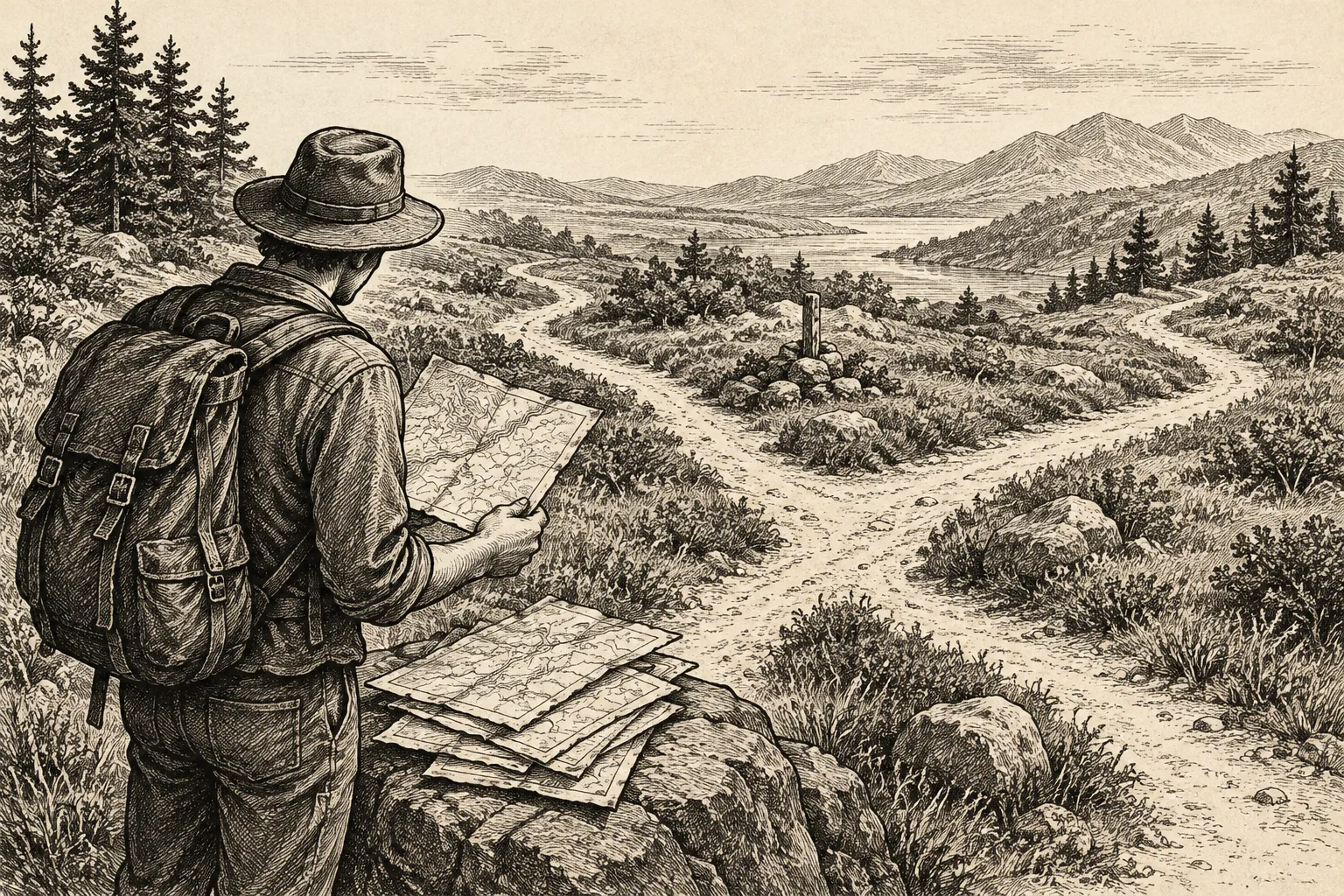
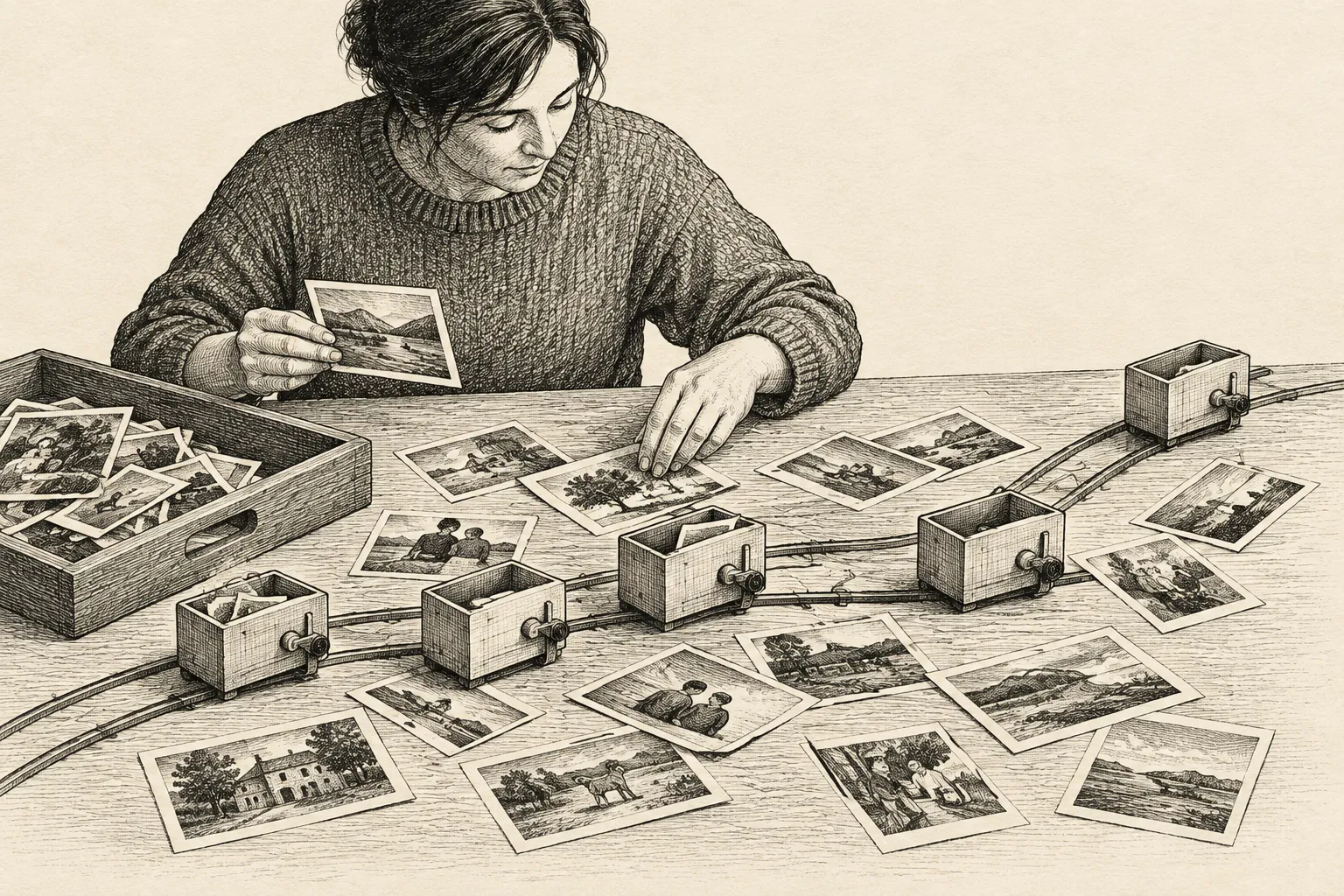 ↗05 / TOP VOTED · 6 MONTHSCode worlds give visual agents places to practiseAn agent can practise in a world whose rules stay in code while its view is generated from the scene’s…↗06 / TOP VOTED · 6 MONTHSRecorded searches could help coding agents choose their next experimentsThe study asks whether an automated search can improve how it chooses its next attempts without…
 ↗
PODCAST / ENGLISH EDITION
The front-page episode covers the papers and news; each paper also has its own short conversation.
Both voices are AI-generated with OpenAI. This is a scripted editorial conversation, not a recording of the authors.
The authors ask how a small language model can learn from new examples without losing as much of what it already knows. Their…
The study asks whether an image can be represented with a compact whole-image description plus extra detail in selected places. The…
An unfinished image can be passed between different image generators if its internal form is translated first. The authors call their…
An image model can change both what it remembers and the rules for updating that memory while it processes one image. To test this…
An agent can practise in a world whose rules stay in code while its view is generated from the scene’s shape. In AgentGarten, a…
The study asks whether an automated search can improve how it chooses its next attempts without repeatedly paying to run every…
FROM THE NEWS DESK
Editorial explanations of the sources: examples and possible uses are distinguished from what the source establishes.
People and society BBC · 09-10-2026 · news report
The BBC reports that Signal leader Meredith Whittaker sees careless use of AI as a more immediate danger than fears of machines turning against people. Her central point is that people may trust faulty information when the stakes are high. She cites an alleged incident, reported by CNN, in which a chatbot invented information about a Chinese vessel.
Imagine a manager acting on a workplace chatbot’s false safety warning without checking it. The warning is made up, but the decision has real consequences. This is an illustration, not an incident established by the BBC report.
In high-stakes work, give people time to check AI-generated information against reliable sources before acting on it.
The alleged chatbot incident is not established by this report. Separately, Whittaker links Project Maven to a US strike on a school in Iran, but the US military has not released its investigation findings. Palantir says there is no evidence its software was at fault.
The warning is about people relying on unreliable AI, not proof that AI acts on its own.
Was this explanation easy to understand?
Tools and building Hugging Face Blog · 07-10-2026 · company announcement
NVIDIA says adapted Nemotron models reached gold-medal level at the 2026 International Olympiad in Informatics, in an unofficial coding run that was not ranked, and at the 2026 International Mathematical Olympiad, where official graders scored the submitted proofs. Its central idea is that training a model for a task works best when the system can also check and revise its answers.
Imagine writing a recipe, asking someone to spot a missing step, and then fixing it. That is an everyday illustration of the draft, check, and revise process NVIDIA describes—not a test of the models.
A coding assistant could use a similar process to draft a solution, test it, and revise it before a developer reviews the result.
The coding run was unofficial and outside the contest ranking. The mathematics proofs received official grading, but these contest results do not establish how reliably the systems would handle everyday work.
NVIDIA attributes the results to both fine-tuning Nemotron for each task and giving it a way to evaluate and improve its answers.
Was this explanation easy to understand?
ENGLISH EDITION / PAPER 01 · NEW / EDITOR PICKS
Why it matters to youIf you adapt a small language model for a specialist task, you may need it to keep doing its old tasks too. This paper tests a training approach intended to help with both; it does not test a workplace deployment.
The authors ask how a small language model can learn from new examples without losing as much of what it already knows. Their approach, SynthSelf, has a somewhat larger model from the same family rewrite each example in its own words. It keeps a rewrite only when a check finds that its answer matches the original, then trains the smaller model on the kept rewrites. The authors’ aim is to give the small model useful new examples that resemble the kind of answers it already produces.
The authors ask how a small language model can learn from new examples without losing as much of what it already knows. Their approach, SynthSelf, has a somewhat larger model from the same family rewrite each example in its own words. It keeps a rewrite only when a check finds that its answer matches the original, then trains the smaller model on the kept rewrites. The authors’ aim is to give the small model useful new examples that resemble the kind of answers it already produces.
Hypothetical illustration, not a study result: suppose a small model is being taught to answer a science question. A related, larger model restates a supplied explanation while keeping its final answer. An answer check rejects a rewrite that changes that answer; the small model trains on a retained rewrite.
In the authors’ average across four new-task settings and three Qwen2.5-Instruct base-model sizes, both SynthSelf variants had a reported acquisition score of 56.4, versus 52.2 for standard fine-tuning; acquisition scores describe performance on the new-task tests. Across the 14 retention tasks, the unchanged base models’ average score was 42.8, while the SynthSelf variants scored 41.7 and 41.8. Thus, the SynthSelf variants’ retention averages were slightly below the unchanged base models’ average. That retention comparison is distinct from the new-task comparison with standard fine-tuning. The authors also report acquisition gains over distillation methods using the same aligner, while noting no significant improvement over those methods in the medical domain.
Training for one new job can change how a model answers other questions. The authors investigate whether rewriting and checking examples before training can improve that trade-off for small models, whose own attempts to teach themselves may be unreliable.
A possible use is preparing specialist training examples for a small model when both new-task performance and earlier abilities matter. The paper evaluates benchmark tasks, not an installed assistant or a production training service.
The authors state that SynthSelf requires a larger model from the same family. They say the medical-domain comparison may offer little added benefit from supplying demonstrations because the aligners may already have perfect knowledge of the training data. In the science experiments, reasoning demonstrations were model-generated; the authors filtered the science evaluation pool to questions for which a correct demonstration existed, although all methods were scored on the same pool. They report one preselected training seed per experimental cell. The source is an arXiv preprint, not a claim of peer review. As a general PtoP note, benchmark results do not establish performance in a deployed workplace system.
FROM PAPER TO PRACTICE
Conceptual exercise only: the supplied paper gives no verified installation instructions or official code repository. You need a few example questions, original answers, and a way to check final answers; using or training models may require access and computing resources, with cost unspecified here. Installation is unverified.
An n8n workflow is not appropriate here: the paper studies model training and benchmark evaluation, and supplies no verified n8n integration.
Was this explanation easy to understand?
ENGLISH EDITION / PAPER 02 · NEW / EDITOR PICKS
Why it matters to youIf you build tools that store or generate pictures, this paper offers a way to think about spending limited image capacity where detail is needed. The authors test the approach on ImageNet images, not in a working archive or design tool.
The study asks whether an image can be represented with a compact whole-image description plus extra detail in selected places. The authors’ MixTok system uses that combination to reconstruct images and to generate new ones. First comes the whole-image representation. Think of a photograph with a broad sky and a patterned coat. MixTok turns the entire image into a short sequence of global tokens—small stored pieces of image information—and expands them into a base layout covering the picture. In the main configuration, the whole-image encoder is TiTok-L-32. Next comes selected local refinement. A scoring component, called a router, ranks places in that layout where extra detail may help. A top-p selection rule chooses how many places to refine for each image, subject to a target average token budget. At those places, features from the LlamaGen VQ-16 local-grid encoder replace features derived from the global tokens. For reconstruction, the scorer can use both branches and the base reconstruction. Finally, a shared decoder turns the mixed layout back into an image. Generation has a distinct route. One model first generates global tokens. A separate scorer chooses refinement places using only the resulting base layout, because the local features used by the reconstruction scorer are not available yet. Another model generates local tokens at the chosen places. The shared decoder then produces the image.
The study asks whether an image can be represented with a compact whole-image description plus extra detail in selected places. The authors’ MixTok system uses that combination to reconstruct images and to generate new ones. First comes the whole-image representation. Think of a photograph with a broad sky and a patterned coat. MixTok turns the entire image into a short sequence of global tokens—small stored pieces of image information—and expands them into a base layout covering the picture. In the main configuration, the whole-image encoder is TiTok-L-32. Next comes selected local refinement. A scoring component, called a router, ranks places in that layout where extra detail may help. A top-p selection rule chooses how many places to refine for each image, subject to a target average token budget. At those places, features from the LlamaGen VQ-16 local-grid encoder replace features derived from the global tokens. For reconstruction, the scorer can use both branches and the base reconstruction. Finally, a shared decoder turns the mixed layout back into an image. Generation has a distinct route. One model first generates global tokens. A separate scorer chooses refinement places using only the resulting base layout, because the local features used by the reconstruction scorer are not available yet. Another model generates local tokens at the chosen places. The shared decoder then produces the image.
Hypothetical illustration, not a test result: for a picture of a plain sky above a patterned coat, the broad image representation might carry much of the sky, while selected local tokens help describe parts of the coat’s pattern. The paper’s scoring system, not a hand-written rule about coats, decides where to refine.
For reconstruction on all 50,000 ImageNet validation images at 256 × 256 resolution, the authors report an rFID of 1.1950 for their main MixTok configuration using TiTok-L-32 and LlamaGen VQ-16, with approximately 128 content tokens per image on average. For class-conditional generation with the same main configuration, they report a mean gFID of 1.9511 across four sampling seeds, each with 50,000 generated images, and a mean of 130.66 content tokens. rFID compares the distribution of reconstructed images with real images; gFID makes that comparison for generated images. Lower scores are better for both. These scores describe image-set similarity, not whether every individual image preserves its details.
The authors address two allocation questions together: which parts of an image get extra detail, and how much extra detail each image gets. That differs from giving every place—or every image—the same allotment.
Possible application, not a demonstrated deployment: image-tool developers could explore whether a whole-image-plus-selected-detail representation suits their own pictures and resource limits.
The authors say reconstruction still requires dense local-grid encoding, and the second-stage generator still operates on the full spatial grid despite generating tokens only at selected places. Their evaluation is limited to ImageNet at 256 × 256 resolution and a narrow range of average token budgets. Selected positions are not counted as content tokens, although the authors account for that position information separately in their estimated bitrate. They also note that an image generator may inherit training-data biases or be misused to make misleading imagery. General PtoP note: this source is an arXiv preprint; its benchmark results are not a tested deployment.
FROM PAPER TO PRACTICE
Conceptual repository exercise; installation and execution are unverified here. Prerequisite: a browser and access to the paper-linked public repository. Reading is free, but running the reported training or evaluation requires external ImageNet data, checkpoints and other assets that the repository does not redistribute; the documented training targets multiple graphics processors.
An n8n workflow is not a useful example here: the paper reports an experimental image-model pipeline, not a verified n8n integration or a ready-to-use service.
Was this explanation easy to understand?
ENGLISH EDITION / PAPER 03 · NEW / EDITOR PICKS
Why it matters to youIf you build tools that create images from written requests, this paper offers a possible way to hand an unfinished image from one generator to another. The authors test that idea in research settings, not in a deployed design tool.
An unfinished image can be passed between different image generators if its internal form is translated first. The authors call their translator InstantFusion. Imagine one painter making the rough layout and another adding detail: the second needs a usable version of the first painter’s work, not just a request to start over. Here, that unfinished work is a latent state—an image represented internally as numbers. Each generator gets a small translator, called a latent autoencoder, that moves its state into and out of a shared latent space. During training, the authors teach the translators both to preserve the state and to align the direction of its next denoising step—the gradual process that turns noise into an image. The generators themselves remain frozen. At generation time, InstantFusion translates the sender’s state for a receiver, which continues the image. A separate rule looks for a point where the sender’s predictions of the finished image have become stable enough to attempt the handoff.
An unfinished image can be passed between different image generators if its internal form is translated first. The authors call their translator InstantFusion. Imagine one painter making the rough layout and another adding detail: the second needs a usable version of the first painter’s work, not just a request to start over. Here, that unfinished work is a latent state—an image represented internally as numbers. Each generator gets a small translator, called a latent autoencoder, that moves its state into and out of a shared latent space. During training, the authors teach the translators both to preserve the state and to align the direction of its next denoising step—the gradual process that turns noise into an image. The generators themselves remain frozen. At generation time, InstantFusion translates the sender’s state for a receiver, which continues the image. A separate rule looks for a point where the sender’s predictions of the finished image have become stable enough to attempt the handoff.
Hypothetical illustration, not a reported test: for a request to draw a cup on a table, one generator could establish the cup’s position before another takes over to finish the image. The bridge would translate the unfinished internal image; it would not simply pass the same internal numbers straight across.
In the authors’ cross-model generation evaluation, Qwen-Image + SD3 scored 35.06 on GenEval-v2, compared with 22.14 for the SD3 base model. GenEval-v2 is a benchmark score used here to assess how generated images follow requests; the figures are scores, not percentages or a count of successful workplace tasks. In a separate acceleration evaluation, the authors report 4.373 seconds per image for Z-Image-Turbo + Qwen-Image, compared with 18.84 seconds per image for Qwen-Image alone. These are different named configurations in paper evaluations. The authors also report that reconstruction quality declines after repeated trips through the shared space.
Image generators often use internal forms that cannot simply be exchanged. The authors’ approach treats translation of the unfinished image, and agreement about what happens next, as separate problems. That gives teams a way to think about combining existing generators without changing their main model weights.
The authors study cross-model image generation, faster generation through model handoffs, combining generators tuned for different preferences, and transferring guidance from Qwen-Image to SD3 during training. These are paper experiments, not claims that the method is available as a finished workplace service.
The authors state that the method currently relies on a shared autoencoder and compatible time settings across generators. Running a hybrid also requires multiple frozen generator backbones at once, raising memory and storage needs. Their reconstruction tests show errors accumulating over repeated translations. The source is an arXiv preprint; as a general PtoP note, a benchmark result is not evidence of performance in a deployed design workflow.
FROM PAPER TO PRACTICE
The official repository provides a walkthrough, but this installation has not been independently verified. Its model weights and training data are not bundled; access terms and costs are not specified in the supplied README.
n8n, a workflow-automation tool, is not needed for this experiment: the verified README describes local training and image-generation scripts, not an n8n integration.
Was this explanation easy to understand?
ENGLISH EDITION / PAPER 04 · TOP VOTED · 6 MONTHS
Why it matters to youIf you build tools that sort images or locate objects in them, this paper offers a possible design for the part of a model that reads an image. The authors test it on research image-recognition tasks, not in a workplace deployment.
An image model can change both what it remembers and the rules for updating that memory while it processes one image. To test this idea, the authors built VisionHOPE, a visual backbone—the part of an image system that extracts useful features. It scans image features in both directions across rows and columns. As each scan proceeds, linked memories update the stored content and the settings that govern later updates. Those memories start from learned values for each image; the paper is describing adaptation within an image, not a model that keeps learning from one user's images indefinitely.
An image model can change both what it remembers and the rules for updating that memory while it processes one image. To test this idea, the authors built VisionHOPE, a visual backbone—the part of an image system that extracts useful features. It scans image features in both directions across rows and columns. As each scan proceeds, linked memories update the stored content and the settings that govern later updates. Those memories start from learned values for each image; the paper is describing adaptation within an image, not a model that keeps learning from one user's images indefinitely.
Hypothetical illustration, not a paper result: while examining a photograph of a crowded shelf, a scan encounters a partly hidden mug. Earlier parts of the scan could affect both what the model has stored about the shelf and how it handles later image features. This does not show that VisionHOPE identifies mugs reliably in practice.
On ImageNet-1K image classification, the authors report 82.3% top-one accuracy for P-VisionHOPE-S, the small, single-resolution version, trained from scratch and evaluated using one crop per validation image at 224 × 224 resolution. Top-one accuracy counts how often the model's first-choice category is correct. On ADE20K image-region classification, the authors report 49.4% mean intersection over union for VisionHOPE-T, the tiny hierarchical version used with UPerNet after ImageNet pretraining. That score averages how much predicted category regions overlap the reference regions. The authors also report object-detection and object-mask results on COCO using ImageNet-pretrained hierarchical backbones with Mask R-CNN. In an ablation on P-VisionHOPE-S, removing the soft injection cap caused numerical divergence early in training.
Most of the image-model designs discussed by the authors can respond differently to each image, but their rules for producing updates remain fixed while that image is processed. VisionHOPE tests a different arrangement: some of those rules evolve during the scan. Its benchmark results show how that arrangement performed in the authors' named research settings.
The tested tasks are image classification, object detection, and assigning categories to image regions. Using this backbone inside a particular organisation's tool would be a possible application, not a deployment demonstrated by the authors.
The authors say they have not evaluated VisionHOPE as a visual encoder in multimodal large language models, or validated it on medical imaging or remote sensing. The step-by-step mathematical size bound applies to the sequential memory update; for the grouped implementation, the stated bound is relative to each chunk's starting memory. The efficiency measurements use the hardware and settings named in the paper, rather than a workplace system. General PtoP note: this source is an arXiv preprint, not evidence of peer review or a tested deployment.
FROM PAPER TO PRACTICE
Safe conceptual exercise; installation is unverified because the supplied text does not provide a usable code or model link. Prerequisites: access to the paper and a few images you may examine. Access terms and computing costs for a runnable model are not specified.
An n8n automation workflow is not appropriate to specify here: the supplied text gives no verified runnable model or code link to connect to one.
Was this explanation easy to understand?
ENGLISH EDITION / PAPER 05 · TOP VOTED · 6 MONTHS
Why it matters to youIf you build practice tasks for an AI agent, this work offers a possible way to pair editable rules with generated views. The paper studies agents practising in such worlds, not their performance in a real workplace.
An agent can practise in a world whose rules stay in code while its view is generated from the scene’s shape. In AgentGarten, a simulator—a program that keeps track of objects and applies rules—decides what happens after each action. A shared neural renderer, a trained model that makes images, turns information about the visible shape into the agent’s next camera view. The agents in the study act from those views, review what happened, and leave written playbooks for agents in later rounds.
An agent can practise in a world whose rules stay in code while its view is generated from the scene’s shape. In AgentGarten, a simulator—a program that keeps track of objects and applies rules—decides what happens after each action. A shared neural renderer, a trained model that makes images, turns information about the visible shape into the agent’s next camera view. The agents in the study act from those views, review what happened, and leave written playbooks for agents in later rounds.
Hypothetical illustration, not a reported test: in a coded storeroom, an agent pushes a crate toward a doorway. The simulator decides whether the crate fits and records its new position; the renderer supplies the camera view. A later agent could read a playbook note saying to check the doorway from the side before pushing.
In the authors’ sequential one-hider, one-seeker hide-and-seek variant, pretrained agents seeing neural-rendered first-person views used panels to build shelter by round 4 and used a ramp to cross walls by round 10. In the separate one-lane bridge world, both cars arrived in every round; the reported time to swap ends was 71 seconds in round 1 and 41 seconds in round 4. That table reports one episode per round. For rendering speed, the authors report 36.5 video frames per second for their served renderer configuration on one NVIDIA H100 graphics processor, at 480 × 832 output, with four denoising steps, hand-written kernels and a tiny decoder. Frames per second counts generated video images, not successful agent actions.
The design gives researchers separate control over what happens in a world and what an agent sees. The authors’ experiments also show agents using written experience across rounds in several authored tasks. That is evidence about these virtual settings, not evidence of general learning across new jobs.
A possible use is making visual practice tasks whose layouts or rules can be edited in code. The paper reports practice inside authored virtual worlds; it does not establish that lessons transfer to physical equipment or workplace tasks.
The authors say the hide-and-seek comparison with an earlier reinforcement-learning study is not a direct measure of learning efficiency: their agents began pretrained, while the earlier agents learned from scratch and received object state rather than rendered views. The four additional worlds report one episode per round, and the authors built the worlds in the report one at a time. They also note that depth and surface normals do not specify every relevant fact, such as a wheel’s rotation; small structures can be lost when shape information is reduced, and visual history can lose attributes after long occlusions. The repository README lists the renderer as available but the code worlds, practice loop, streaming server and interactive frontend as forthcoming. General PtoP note: this is an arXiv preprint, not a claim of peer review.
FROM PAPER TO PRACTICE
A safe conceptual exercise using the official repository’s README; installation and the full practice loop have not been independently verified.
n8n is not a natural fit for the paper’s low-latency simulator-and-renderer interaction loop; a proposed use for it would be archiving completed playbook notes, not serving the interactive views.
Was this explanation easy to understand?
ENGLISH EDITION / PAPER 06 · TOP VOTED · 6 MONTHS
Why it matters to youIf you run an automated search for faster code, you may be able to use its past attempts to decide what to try next. The authors tested that idea on coding, mathematics, and agent-setup tasks—not in an everyday workplace deployment.
The study asks whether an automated search can improve how it chooses its next attempts without repeatedly paying to run every proposed search strategy. The authors’ answer is to save the attempts and outcomes from a completed search, then let alternative strategies travel through those records. Imagine, hypothetically, a coding assistant that has tried several ways to speed up a program. One plan revisits a promising attempt; another starts a new line of work. It can compare those plans against attempts already recorded before using a plan in a new search. The authors call this record-based test a replay simulator. In Dream-RSI, a separate exploration policy—the rules for choosing branches, running attempts together, and stopping—changes between searches. The underlying coding agent does not change.
The study asks whether an automated search can improve how it chooses its next attempts without repeatedly paying to run every proposed search strategy. The authors’ answer is to save the attempts and outcomes from a completed search, then let alternative strategies travel through those records. Imagine, hypothetically, a coding assistant that has tried several ways to speed up a program. One plan revisits a promising attempt; another starts a new line of work. It can compare those plans against attempts already recorded before using a plan in a new search. The authors call this record-based test a replay simulator. In Dream-RSI, a separate exploration policy—the rules for choosing branches, running attempts together, and stopping—changes between searches. The underlying coding agent does not change.
Hypothetical illustration, not a reported experiment: A team searching for a faster image-processing routine records each candidate, its parent candidate, and its measured speed. A proposed policy might spend less effort refining an unpromising branch and more on another recorded branch. Replay can reveal the outcomes of those saved attempts; it cannot reveal what an attempt outside the record would have achieved.
For the Lasso solver task, which searches for code used in statistical model fitting, the authors report that Dream-RSI with Gemini-3.1-Pro reached an average runtime of 2931.0 ms on six held-out datasets using 317 discovery-agent calls. Recursive Fixed Exploration with the same model reached 3587.1 ms using 550 calls. Runtime measures how long the discovered solver took; calls count attempts made during discovery. The authors note that the Pro average was driven by the RCV1 dataset, while Dream-RSI’s solver was slower on the other five. On the ConvDiv task in KernelBench, they report 2.09× higher kernel performance for Dream-RSI with Gemini-3.1-Pro than Recursive Fixed Exploration under comparable discovery budgets; performance is inverse runtime, so higher means faster. For harness optimization using Claude Opus 4.8 with Claude Code, they report that Dream-RSI raised the Terminal-Bench 2.1 full-suite score from 0.7247 for the seed harness to 0.8090. The authors omitted a fixed-policy comparison for this harness result because they estimated an additional full search would cost over $100,000.
The proposed change is to the search process, not the language model’s weights. The authors report that reusing search history improved discovery-agent-call efficiency in several of their tested settings. That matters when each new candidate requires another agent call and evaluation.
The paper studies automated discovery rather than a ready-to-install work tool. A possible use is to review how an expensive coding or optimization search allocates its next attempts, provided that search records its branches and measured outcomes.
Replay can reveal only outcomes already present in a recorded tree; it cannot produce an outcome for an untried attempt. The Lasso search used the same 17 synthetic discovery instances as SimpleTES and was also evaluated on six held-out downstream datasets. The authors caution that their comparisons with SimpleTES use different model backbones. For harness optimization, they omitted the fixed-policy comparison because they estimated an additional full search would cost over $100,000; that result therefore does not measure Dream-RSI against a fixed exploration policy in the harness setting. General PtoP note: this source is an arXiv preprint, not a claim of peer review, and benchmark results are not a workplace deployment.
FROM PAPER TO PRACTICE
Safe conceptual exercise; installation is unverified because the official repository says its full codebase and reproduction scripts are being prepared. Prerequisites: a browser, paper, and a few records from a search you are permitted to examine. This exercise needs no model access or paid calls; the cost and access requirements for running Dream-RSI are not established by the available README.
An n8n workflow is not appropriate here: the reported method revises executable search policies and replays structured discovery histories, while the official repository does not yet provide a released codebase or reproduction scripts for an integration.
Was this explanation easy to understand?
COMPARISON
Compare topics, possible uses and limits. Each result remains attributed to its own paper.
| Paper | Central idea | Possible use | Limit |
|---|---|---|---|
| Small language models can learn new tasks with less forgetting | The authors ask how a small language model can learn from new examples without losing as much of what it already knows. Their approach, SynthSelf, has a somewhat larger… | A possible use is preparing specialist training examples for a small model when both new-task performance and earlier abilities matter. The… | The authors state that SynthSelf requires a larger model from the same family. They say the medical-domain comparison may offer little… |
| Selective image detail could make visual tokens more compact | The study asks whether an image can be represented with a compact whole-image description plus extra detail in selected places. The authors’ MixTok system uses that… | Possible application, not a demonstrated deployment: image-tool developers could explore whether a whole-image-plus-selected-detail… | The authors say reconstruction still requires dense local-grid encoding, and the second-stage generator still operates on the full spatial… |
| A shared bridge could let image generators finish each other’s work | An unfinished image can be passed between different image generators if its internal form is translated first. The authors call their translator InstantFusion. Imagine… | The authors study cross-model image generation, faster generation through model handoffs, combining generators tuned for different… | The authors state that the method currently relies on a shared autoencoder and compatible time settings across generators. Running a hybrid… |
| VisionHOPE tests an image model that changes how it learns mid-scan | An image model can change both what it remembers and the rules for updating that memory while it processes one image. To test this idea, the authors built VisionHOPE, a… | The tested tasks are image classification, object detection, and assigning categories to image regions. Using this backbone inside a… | The authors say they have not evaluated VisionHOPE as a visual encoder in multimodal large language models, or validated it on medical… |
| Code worlds give visual agents places to practise | An agent can practise in a world whose rules stay in code while its view is generated from the scene’s shape. In AgentGarten, a simulator—a program that keeps track of… | A possible use is making visual practice tasks whose layouts or rules can be edited in code. The paper reports practice inside authored… | The authors say the hide-and-seek comparison with an earlier reinforcement-learning study is not a direct measure of learning efficiency… |
| Recorded searches could help coding agents choose their next experiments | The study asks whether an automated search can improve how it chooses its next attempts without repeatedly paying to run every proposed search strategy. The authors’… | The paper studies automated discovery rather than a ready-to-install work tool. A possible use is to review how an expensive coding or… | Replay can reveal only outcomes already present in a recorded tree; it cannot produce an outcome for an untried attempt. The Lasso search… |
ARCHIVE
The last two issues. Every earlier edition is in the archive.
11