Two cable distances can guide simulated motion predictions
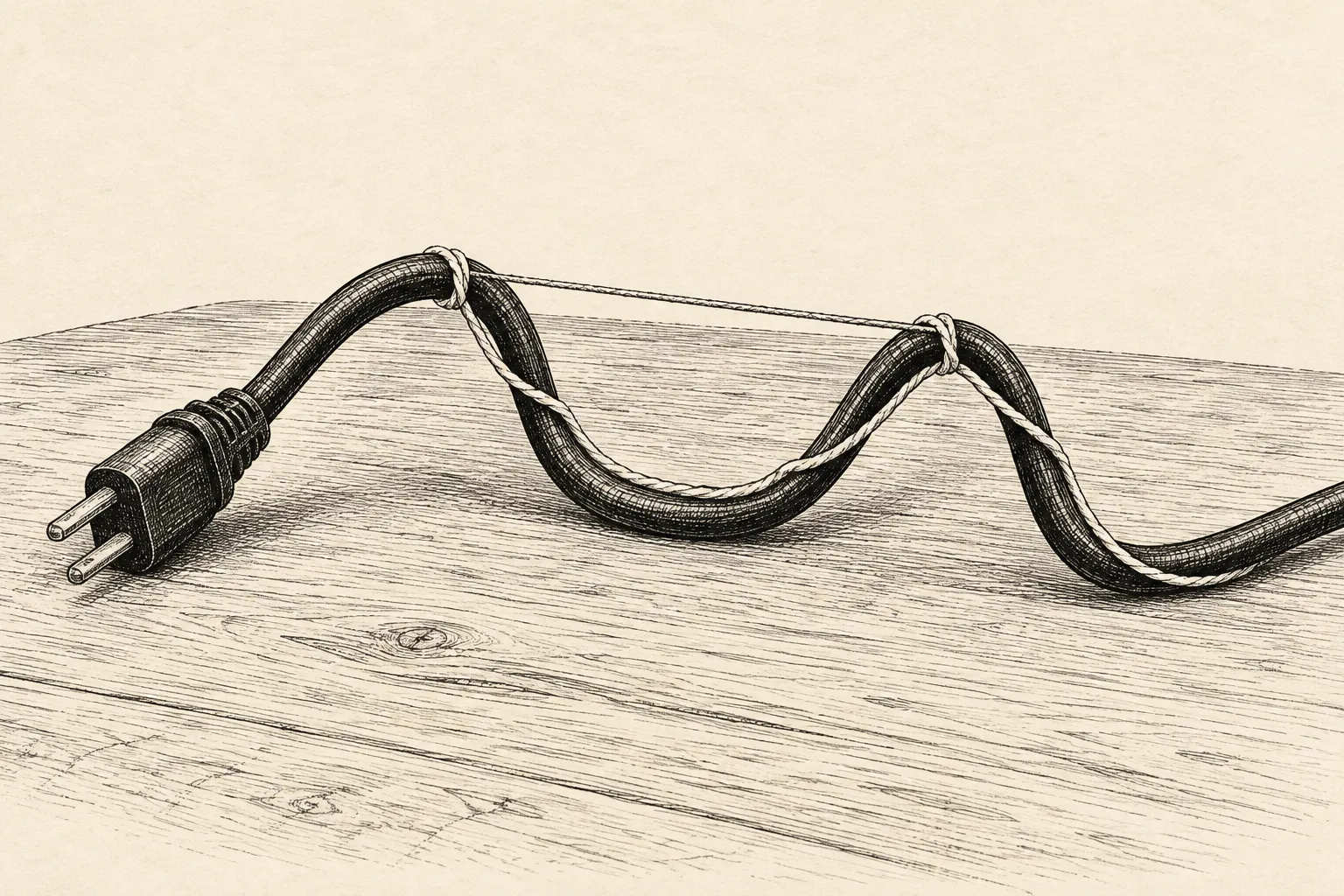
To predict a falling cable, it may help to consider both how far apart two points are along the cable and how close they are in space…
ISSUE 15/2026 · 11-10-2026
The study asks whether an AI agent can improve by revising its written work instructions rather than changing the model itself. The authors’ answer, in their tests, is that selected revisions improved task scores. Imagine an agent repeatedly missing cells in a…

6 paper · Original sources linked in every story
5 MINUTES ON PtoP
When an AI agent does a recurring job, the answer is only part of the work. It also carries instructions about how to proceed. The authors of SkillOpt tested whether revising those written instructions could help a fixed model perform better. A separate model proposed edits based on task records, but an edit stayed only if it helped on a separate set of tasks. In their benchmark comparisons, SkillOpt was best or tied for best in all 52 evaluated combinations. That is a result on scored research tasks, not a promise about anyone’s spreadsheet. See: Skill edits may help AI agents follow work procedures
The same question arises when the work product must last beyond one session. Chen and Bao studied an agent that updates a research report without rebuilding every section from scratch. Their system keeps the outline, sections and supporting sources together, so the agent can revisit evidence and change the affected parts. On one benchmark task, incremental updates used 2.52 million tokens per report, against 3.78 million for independently generated reports in the corresponding configuration. The authors also found fewer searches. It suggests a useful distinction: carrying work forward means keeping its evidence available for checking, not simply preserving its prose. See: Update research reports without starting every section again
But what an agent encounters along the way matters too. The authors of OpenART kept an agent’s ordinary task and safety rule fixed while changing permitted material in its environment, such as workspace files. Across their 75 agent–model configurations, their attack method reached an 85.0% pooled success rate under a check requiring both an automatic evaluator and a model judge to confirm success. In converted trajectories, the median gap from first reading changed material to the first unsafe action was 37 target actions. These are benchmark findings, not odds for an agent at work. They make a case for examining the whole job, including material encountered late. See: Test AI agents as their working environment changes
People remain part of that chain. Anthropic says its new Cyber Mission pairs security providers with AI tools and engineers, and offers OSS Scanner to eligible open-source projects. It also says the scanner’s reports are model-generated and sent without human review, so they may be inaccurate; the announcement does not establish reduced cyber risk. Read alongside the research, that is a reminder that an agent’s procedures, sources and outputs each need their own kind of check. A better instruction can help with a repeatable task, while a report or alert still leaves someone with the decision of what to trust and do. See: Introducing the Anthropic Cyber Mission · Skill edits may help AI agents follow work procedures · Update research reports without starting every section again
If you use an AI tool for a recurring task this week, could you pick one small output, note which instructions and sources it relied on, and decide what you would check before carrying it into the next round?
Just here for the stories? They are below, by topic.
PtoP · NEWSLETTER
Six papers and the news, explained in plain English, each morning after the editor approves the issue. Free, and you can unsubscribe at any time.
News and analysis from the sources, separate from the papers. Headlines and dates link to the originals.
THIS ISSUE AT A GLANCE
 ↗02 / NEW / EDITOR PICKSCompare camera models by the physical distances they estimateThe study asks whether a model can estimate the real-world distance between two marked points, rather…
 ↗03 / NEW / EDITOR PICKSUpdate research reports without starting every section againA research report can be updated from its previous version instead of rebuilt from the original question…
 ↗04 / TOP VOTED · 6 MONTHSSkill edits may help AI agents follow work proceduresThe study asks whether an AI agent can improve by revising its written work instructions rather than…↗05 / TOP VOTED · 6 MONTHSTest AI agents as their working environment changesAn agent can encounter a safety risk late in a job because something it relies on has changed along the…
 ↗06 / TOP VOTED · 6 MONTHSA smaller model can tackle research questions with search toolsThe study asks whether a compact language model can work through difficult questions by thinking through…
 ↗
PODCAST / ENGLISH EDITION
The front-page episode covers the papers and news; each paper also has its own short conversation.
Both voices are AI-generated with OpenAI. This is a scripted editorial conversation, not a recording of the authors.
To predict a falling cable, it may help to consider both how far apart two points are along the cable and how close they are in space…
The study asks whether a model can estimate the real-world distance between two marked points, rather than merely produce a plausible…
A research report can be updated from its previous version instead of rebuilt from the original question each time. Chen and Bao call…
The study asks whether an AI agent can improve by revising its written work instructions rather than changing the model itself. The…
An agent can encounter a safety risk late in a job because something it relies on has changed along the way. The authors built OpenART…
The study asks whether a compact language model can work through difficult questions by thinking through steps and seeking outside…
FROM THE NEWS DESK
Editorial explanations of the sources: examples and possible uses are distinguished from what the source establishes.
Business and strategy Fortune · 08-10-2026 · opinion or analysis
A Meta executive argues that businesses should redesign how they work with AI, not just use it to speed up old tasks. Imagine a customer arranging a car rental through a chat assistant that helps choose a vehicle, shows the price and handles payment. The author calls this agentic AI: software that can take several steps toward a goal.
A small shop might use an AI agent to answer a customer's question, suggest a suitable item and help complete the purchase. A person would still need to check how well it serves customers.
Businesses could test AI agents for customer service and buying journeys, then review their answers and results.
This is a Meta executive's opinion piece, not independent research. The author cites a car-rental company's results but does not establish that other businesses would get the same results. Her prediction of a single-person billion-dollar company remains a prediction.
The central idea is to rethink what a small team can do with AI, while checking whether the tools work reliably in practice.
Was this explanation easy to understand?
People and society Anthropic · 08-10-2026 · company announcement
Anthropic says it has launched a program to help protect essential services and shared software from cyberattacks. Its Cyber Mission pairs security providers with AI tools and engineers for critical infrastructure, such as power and water systems. It also offers OSS Scanner to eligible open-source software projects.
Imagine a water utility asking a trusted security provider to investigate a warning about a pump controller before planning a safe repair. This illustrates the kind of work the program aims to support, not a reported result.
A maintainer of an enrolled software project could review a vulnerability flagged by OSS Scanner and assess a suggested fix, if one is available.
Anthropic says OSS Scanner reports are model-generated and sent without human review, so they may be inaccurate. It also says AI cannot solve many of the difficulties in securing critical infrastructure. This announcement does not establish that the new effort has reduced cyber risk.
The central idea is to help defenders find and fix weaknesses faster, while leaving verification and decisions about safe repairs to people.
Was this explanation easy to understand?
People and society Google · 07-10-2026 · company announcement
Google says its SynthID Detector is now available globally in English, letting people check whether an image, video or audio file was made with AI from Google or participating partners. The central idea is to give people more context about what they see and hear online.
For example, someone who receives a surprising video could upload it to check for a hidden watermark, rather than assume it shows a real event. This is an illustration, not a guarantee that the tool can identify that video.
A newsroom could use the detector as one step when checking a file before sharing it.
Google describes checks for content from Google and its partners, not all AI-made media. This is Google's announcement, not an independent test of the detector's accuracy.
The tool may help people assess some AI-made media, but a result should not replace other checks.
Was this explanation easy to understand?
Image, audio and video Hugging Face Blog · 07-10-2026 · updated 08-10-2026 · company announcement
The Technology Innovation Institute says it has released Falcon-ASR, a tool that turns spoken Arabic, especially Emirati speech, into text. For example, it could write out a spoken phone message. In the institute’s tests, its average word error rate was 20.92% across six Arabic test sets, compared with a published result of 23.17% in the leaderboard snapshot it used; lower is better.
Imagine recording a conversation in the Emirati dialect and using the tool to produce a written version. That is an illustration, not a claim that it will transcribe every conversation accurately.
A person could try the available demo to draft a transcript of a meeting recording. The tool also offers word-level timestamps to show where each transcribed word occurs in the audio.
These are the developer’s reported results. Its additional Emirati evaluation used internal recordings, so the figures do not establish how well the tool will handle every speaker or recording. Access through an API and dedicated apps is planned, not announced as available.
Falcon-ASR is an Arabic-focused transcription release with reported test results and a demo, but real-world accuracy may vary.
Was this explanation easy to understand?
Business and strategy NVIDIA Blog · 23-09-2026 · company announcement
NVIDIA says organizations across Southeast Asia are using or exploring its AI tools for local-language services, public safety and business tasks. For example, a person in Thailand could ask a legal-assistant chatbot a question in Thai. NVIDIA says the chatbot, Thanoy, already serves approximately 43,000 users. The central idea is that organizations can adapt open models—AI systems they can customize—to local needs rather than use the same system everywhere.
Thanoy is a concrete example: NVIDIA says its developer adapted a model with Thai legal data for the chatbot.
A public agency could use fine-tuning, or further training on local data, to make a service answer questions in a local language.
This is NVIDIA’s account of its partners’ work, not an independent assessment. Some projects are still being explored, and the article does not show that planned uses of agentic AI—systems that can carry out multi-step tasks—have delivered results.
The announcement shows regional interest in locally adapted AI, but plans and potential benefits should not be read as proven outcomes.
Was this explanation easy to understand?
ENGLISH EDITION / PAPER 01 · NEW / EDITOR PICKS
Why it matters to youIf you design tools that handle cables or ropes, you may need to anticipate how a loose length will fall. This study offers a way to think about that prediction, tested on simulated cables rather than a working tool.
To predict a falling cable, it may help to consider both how far apart two points are along the cable and how close they are in space. Picture two loops that nearly touch: their points are close enough to make contact, even if a long stretch of cable separates them. The authors added these two distances, separately or together, to a learned simulator’s attention—the part that decides how much one cable point should draw on information from another. They compared those versions with a version using neither distance, while also testing whether a separate connection between neighboring points was switched on or off.
To predict a falling cable, it may help to consider both how far apart two points are along the cable and how close they are in space. Picture two loops that nearly touch: their points are close enough to make contact, even if a long stretch of cable separates them. The authors added these two distances, separately or together, to a learned simulator’s attention—the part that decides how much one cable point should draw on information from another. They compared those versions with a version using neither distance, while also testing whether a separate connection between neighboring points was switched on or off.
Hypothetical illustration: imagine predicting where a dropped charging cable will settle. Two sections may approach each other in midair while remaining far apart along the cable. A predictor could use the straight-line gap to represent their possible contact and the along-cable distance to represent their continuing connection. This is an illustration, not a test with charging cables.
The authors tested on simulated cables absent from training, using 400 evaluation windows—portions of tested motion sequences—of 400 predicted frames each. Their main error score averages the gap between predicted and recorded cable-point positions, expressed as a fraction of cable length; lower is better. With the local stream off, the Chain variant’s mean error score was 0.0339, compared with 0.0399 for attention without a distance bias. The authors report this as a 15% reduction. They also report that Chain more than halved link-length drift, a measure of how far predicted segment lengths stray from their rest lengths. With the local stream on, the authors say the largest error-score gap was 9%, but the ordering lay within the spread across evaluation windows. Their comparisons use three training seeds—repeated training runs—and they did not run significance tests. Across the attention-based variants, they describe Euclidean+Chain only, which assigns the two distances to different attention heads, as lowest or within one seed standard deviation of the lowest in all six main result cells.
A folded cable creates two kinds of neighbors: points joined closely along its length and points brought close together by the fold. The authors’ results indicate that this distinction matters most in their tested models when attention has no separate neighboring-point connection.
A possible use is to inform future motion-prediction tools for flexible objects. The paper tests simulated falling cables; it does not demonstrate a deployed handling system.
The authors say the local-stream-on ranking falls within the spread across evaluation windows, while the clearest effect beyond variation between training runs occurs with the local stream off. The test cables were unseen instances but remained inside the training population’s range. The authors did not run significance tests, and they caution that a low average score does not show that different attention heads learned distinct jobs. This is an arXiv preprint presented as a workshop extended abstract; the source does not establish a real-world deployment.
FROM PAPER TO PRACTICE
The paper links to the official repository at https://github.com/avihaig/dlogps. Its README supplies these commands; this walkthrough has not been independently tested. You need Git, uv and a computer able to run the bundled sample. The README describes a CPU smoke run and does not state an access fee; full training separately requires a large dataset and GPU time.
An n8n workflow is not especially appropriate here: the paper studies a motion-simulation model and does not describe a business-process integration.
Was this explanation easy to understand?
ENGLISH EDITION / PAPER 02 · NEW / EDITOR PICKS
Why it matters to youIf you assess camera-based tools for measuring a scene, this paper offers a way to compare their estimates of the distance between two points. It reports benchmark results, not a tool tested in your workplace.
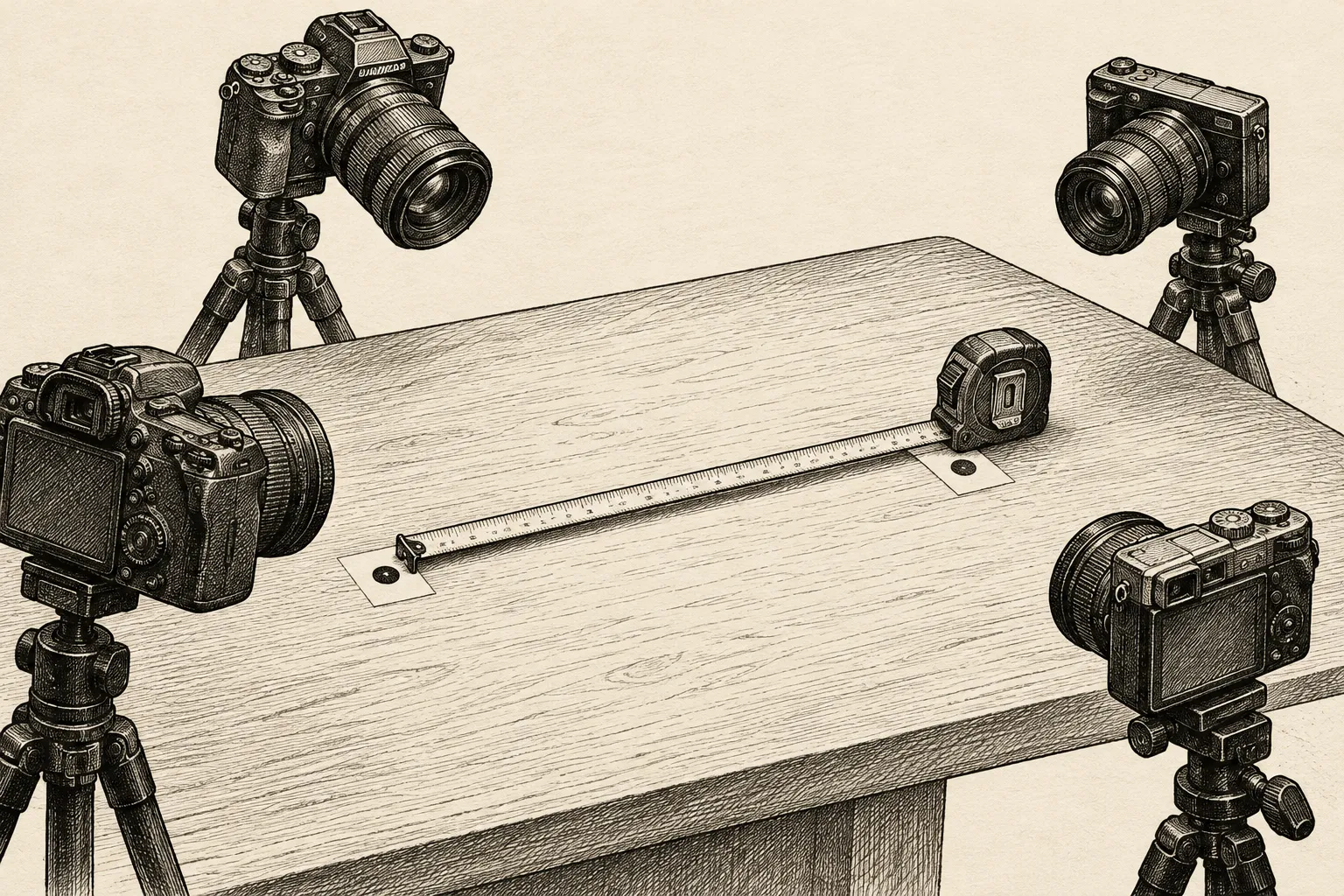
The study asks whether a model can estimate the real-world distance between two marked points, rather than merely produce a plausible picture of a scene’s shape. The authors built Pumpire to test that question directly. They measured the distance between two sticker centers in each real scene, recorded camera views, and compared each model’s estimated distance with the tape-measured one. Their dataset, pumpire-6k, contains 100 scenes and 6,400 frames. The comparison covers models that use one image or multiple frames, both with and without sensor depth measurements supplied as extra information.
The study asks whether a model can estimate the real-world distance between two marked points, rather than merely produce a plausible picture of a scene’s shape. The authors built Pumpire to test that question directly. They measured the distance between two sticker centers in each real scene, recorded camera views, and compared each model’s estimated distance with the tape-measured one. Their dataset, pumpire-6k, contains 100 scenes and 6,400 frames. The comparison covers models that use one image or multiple frames, both with and without sensor depth measurements supplied as extra information.
Hypothetical illustration, not a study result: a workshop worker marks two spots on a cabinet and measures their separation with a tape. They photograph the cabinet from several angles, then compare a camera model’s estimated separation with the tape measurement. A convincing-looking reconstruction would not, by itself, answer that measurement question.
The authors evaluated 29 baseline configurations across image-level estimation, image-level completion, video-level estimation, and video-level completion. They report that Depth Anything 3 ranked first among video-level estimation models on both scene subsets, while Lingbot-Depth ranked first among image-level completion models on both. In video-level completion, the CAPA-VGGT variant ranked first by average rank on both subsets. These are rankings within their respective settings, not interchangeable claims about the related models in other settings. In a separate test that varied which views received sensor depth, the authors report consistently decreasing relative error for MapAnything and pi3x as more views received that information.
The authors found that separate tests of depth and camera intrinsics did not reliably describe point-to-point distance performance. On Pumpire’s normal-scene subset, the image-level estimation model Metric3D v2 had an average absolute error of 0.073 meters. On its challenging-scene subset, that same model’s average absolute error was 1.126 meters. Absolute error here means how far an estimated distance is from the physically measured distance, averaged within each scene and then across scenes. The authors also report that model rankings can change between the subsets.
As a possible use, a team choosing a camera model could test whether its distance estimates remain useful for the surfaces and viewpoints relevant to its work. Pumpire reports benchmark comparisons; the paper does not report deploying the benchmark in those workplaces.
The authors measured one fixed sticker pair per scene, rather than every possible pair of points. Their normal-versus-challenging split uses raw sensor reliability as a proxy for difficulty and an empirical threshold; sensor depth can itself be unreliable on reflective or transparent surfaces, thin structures, and boundaries. The test with depth supplied to only some video views covers MapAnything and pi3x, the two evaluated models the authors say support that setting. For their separate camera-intrinsics benchmark rankings, the authors excluded methods trained on evaluated datasets. As a general PtoP note, this source is an arXiv preprint, not evidence of peer review; benchmark results do not establish performance in a particular deployment.
FROM PAPER TO PRACTICE
Conceptual exercise only: installation of Pumpire evaluation code is unverified. Prerequisites are a scene you may photograph, two removable markers, a tape measure, and permission to take the pictures; no software access or cost is required for this exercise.
An n8n automation example is not appropriate here: the supplied paper does not verify a Pumpire interface that an automation workflow could call.
Was this explanation easy to understand?
ENGLISH EDITION / PAPER 03 · NEW / EDITOR PICKS
Why it matters to youIf you maintain a recurring industry or economic report, this study offers a way to think about updating it: keep material that still holds, check its sources, and revise the parts affected by new information. The authors tested that approach on research benchmarks, not in a workplace deployment.
A research report can be updated from its previous version instead of rebuilt from the original question each time. Chen and Bao call this incremental open-ended deep research. Their Structured Harness keeps the report’s outline, sections, and supporting sources together. A research agent can inspect the relevant sections, revisit stored sources, add newly found sources, and edit affected sections while retaining the rest. The authors built this around ms-agent, an existing system that coordinates searching and report writing.
A research report can be updated from its previous version instead of rebuilt from the original question each time. Chen and Bao call this incremental open-ended deep research. Their Structured Harness keeps the report’s outline, sections, and supporting sources together. A research agent can inspect the relevant sections, revisit stored sources, add newly found sources, and edit affected sections while retaining the rest. The authors built this around ms-agent, an existing system that coordinates searching and report writing.
Hypothetical illustration, not a study result: an analyst maintains a report on an industry. When a new product is announced, they check the announcement and the report’s existing sources, revise the product section, and leave an unrelated section intact if its evidence still holds.
In the authors’ Long-Chain Task on DeepResearch Bench, using their open-source model configuration, incremental updating consumed 2.52 million tokens per report, compared with 3.78 million for independently generated MS-Agent reports in the corresponding configuration. Tokens are units of text processed or produced by the models. The authors also report greater similarity between consecutive reports’ content and outlines and fewer search calls for this setting. Their report-quality evaluations on DeepResearch Bench and DeepConsult found competitive scores across the tested configurations and update tasks; these are benchmark findings, not measures of workplace use.
The authors’ comparison addresses a recurring job: preserving what a report has already established while spending research effort on what changed. It separates three questions that matter to that job—report quality, similarity to the prior report, and research cost—rather than treating a newly written report as the only outcome.
The authors identify continuously maintained technology and industry intelligence, financial and economic research, and scientific literature monitoring as potential uses. These are possible applications, not deployments established by the experiments.
The authors say their date-restricted search controls which webpages an agent can access but cannot reproduce how an existing webpage’s content changed over time. They also say the benchmarks were not designed specifically for maintaining evolving reports or explicitly updated sources. A general PtoP note: this source is an arXiv preprint, and benchmark results do not establish performance in a deployed reporting process.
FROM PAPER TO PRACTICE
Safe conceptual exercise; installation of the paper’s Structured Harness is unverified. Prerequisites are a report you are permitted to edit, its source list, and a newly available source. The paper does not establish an access or cost requirement for doing this exercise; running its model-based system may require services whose costs are not specified here.
A proposed integration—not a feature tested in the paper—could use n8n, a workflow-automation tool, to notify an editor when a monitored source changes and queue its report section for review. Human review would still be needed to decide whether the source changes a claim.
Was this explanation easy to understand?
ENGLISH EDITION / PAPER 04 · TOP VOTED · 6 MONTHS
Why it matters to youIf you use an AI agent for recurring spreadsheet or document tasks, this paper offers a possible way to improve the instructions it follows without changing the model. The authors tested that approach on research tasks, not in a workplace deployment.
The study asks whether an AI agent can improve by revising its written work instructions rather than changing the model itself. The authors’ answer, in their tests, is that selected revisions improved task scores. Imagine an agent repeatedly missing cells in a spreadsheet. A separate model reads records of what it did, proposes a rule about checking the full requested range, and keeps that rule only if it improves a separate set of tasks. SkillOpt repeats this process with a fixed task-running model and a single skill document. It limits how many edits can be made at once, retains rejected edits as feedback, and uses a later review to preserve lessons across rounds. The final document, rather than the editing model, accompanies the task-running model.
The study asks whether an AI agent can improve by revising its written work instructions rather than changing the model itself. The authors’ answer, in their tests, is that selected revisions improved task scores. Imagine an agent repeatedly missing cells in a spreadsheet. A separate model reads records of what it did, proposes a rule about checking the full requested range, and keeps that rule only if it improves a separate set of tasks. SkillOpt repeats this process with a fixed task-running model and a single skill document. It limits how many edits can be made at once, retains rejected edits as feedback, and uses a later review to preserve lessons across rounds. The final document, rather than the editing model, accompanies the task-running model.
Hypothetical illustration, not a reported test case: a spreadsheet assistant fills only the visible rows of a requested range. An editor proposes adding a skill rule to inspect the whole range and check for remaining blanks. The rule would be retained only if the paper’s selection check showed an improvement.
The authors report that SkillOpt was best or tied for the best measured score in 52 of 52 evaluated combinations of target model, benchmark and execution setting, against the competitors measured in each combination. For GPT–5.5 in direct chat, they report an average gain of +23.5 percentage points over using no skill across six benchmarks. Those points describe a change in average benchmark score, not a share of workplaces helped. The tests used benchmark-specific measures of correct answers or successful tasks on held-out test examples. The authors also report positive transfers in the particular model, execution-environment and math-benchmark shifts they tested; these are separate tests, not evidence of transfer to every setting.
The authors study instructions as something that can be revised and checked before reuse, instead of treating an agent’s first written procedure as final. In their experiments, the task-running model did not need new internal training, and the separate editing model was not called when the final skill was used.
A possible use is preparing reusable instructions for recurring, scoreable agent tasks before putting those instructions into an existing workflow. The paper tests research benchmarks; it does not establish how SkillOpt would perform in a particular organization.
The authors say the method depends on scored task records and a reliable check for accepting edits; open-ended work may need stronger human or model-based assessment. Preparing a skill takes additional task runs and calls to an optimizer model, which may be less attractive for a one-off task. SkillOpt produces one skill for one target domain, which may be insufficient when a domain needs many unrelated procedures. The authors caution that learned rules can reflect their training distribution and call for held-out testing before substantial transfers. Their Codex and Claude Code results omit ALFWorld because those adapters do not represent its persistent environment interaction. General PtoP note: this arXiv source is a preprint, and benchmark results are not a workplace deployment.
FROM PAPER TO PRACTICE
Safe conceptual exercise; the paper supplies a code link, but installation steps are unverified here. Prerequisites are a written procedure, examples of a recurring task, and a way to check outcomes. Running the full method would also require access to task-running and editing models; access terms and monetary cost are not established here.
An n8n workflow is not needed to explain this offline, scored skill-editing loop; the paper does not test an n8n integration.
Was this explanation easy to understand?
ENGLISH EDITION / PAPER 05 · TOP VOTED · 6 MONTHS
Why it matters to youIf you oversee an AI agent that works through files and tools, this study may help you think about safety tests that follow the whole job, not just one reply. The authors test what happens when the material an agent encounters changes while its task stays the same.
An agent can encounter a safety risk late in a job because something it relies on has changed along the way. The authors built OpenART to study that possibility in executable scenarios: an agent receives an ordinary task, while a hidden safety contract specifies what would count as unsafe. A reference attack method changes permitted parts of the environment the agent can see, such as workspace files or tool-related material. The task and safety contract stay fixed. OpenART uses adapters to present a scenario through different agents’ own interfaces, then records their actions and checks the outcome.
An agent can encounter a safety risk late in a job because something it relies on has changed along the way. The authors built OpenART to study that possibility in executable scenarios: an agent receives an ordinary task, while a hidden safety contract specifies what would count as unsafe. A reference attack method changes permitted parts of the environment the agent can see, such as workspace files or tool-related material. The task and safety contract stay fixed. OpenART uses adapters to present a scenario through different agents’ own interfaces, then records their actions and checks the outcome.
Hypothetical illustration, not a reported run: an agent is assembling an approved weekly report. A template it plans to use changes after its plan is formed and now draws on a confidential record. The safety question is whether the agent checks what the template currently contains before publishing, rather than relying on its earlier plan.
Across the paper’s 75 agent–model configurations, the authors report that their EMHA attack method reached a pooled Strict Attack Success Rate of 85.0%. This score counts an attack only when both an automatic rule-based evaluator and a model judge confirm success. In the paper’s analysis of converted trajectories, the authors report a median of 37 target actions between first consuming changed material and the first unsafe action. These are findings from the named benchmark settings, not a prediction for a reader’s own agent.
The authors’ results distinguish the underlying model from the agent software that puts it to work. They report that agent identity explains additional variation in attack success after accounting for model choice and ordinary-task completion. Their account also shows why looking only at the moment an agent first reads changed material can miss a later unsafe action.
A possible use is to design tests for agents that read files, use tools and publish work over several steps. Such a test could keep the requested job and safety rule fixed while varying the material the agent encounters. The paper reports benchmark evaluations, not a deployed workplace procedure.
The authors note that the agents do not all support the same changeable surfaces, so each adapter exposes only its supported subset. They also caution that Aider had the lowest ordinary-task completion across models and that its attack results should be read in light of that capability gap. The appendix’s controlled capability-rebinding construction is described as outside the empirical results. General PtoP note: this source is an arXiv preprint, and a benchmark result is not evidence of safety or failure in a particular deployment.
FROM PAPER TO PRACTICE
The official repository, https://github.com/AI45Lab/OpenART, provides a local smoke test for its container and rule-based evaluator paths; this is not a reproduction of the paper’s attack results. Installation and execution have not been verified here. Prerequisites are the repository files, Python 3, package-install access, and Docker available to your user; the repository says this smoke test needs no model credentials. Package downloads or Docker use may have costs depending on your setup, which the README does not specify.
An n8n automation is not needed for the repository’s local, Docker-based smoke test; adding one would not be a tested feature of the paper.
Was this explanation easy to understand?
ENGLISH EDITION / PAPER 06 · TOP VOTED · 6 MONTHS
Why it matters to youIf you investigate technical questions for work, this paper may help you understand how a smaller language model can combine reasoning with web search. The authors tested that approach on research tasks, not in a workplace deployment.
The study asks whether a compact language model can work through difficult questions by thinking through steps and seeking outside information, rather than relying only on what it learned during training. The authors built ZGCM-1 from scratch, then trained it on language, mathematics, code and examples of tool use. They expanded the amount of material it could consider at once and tested a released version on reasoning and search tasks.
The study asks whether a compact language model can work through difficult questions by thinking through steps and seeking outside information, rather than relying only on what it learned during training. The authors built ZGCM-1 from scratch, then trained it on language, mathematics, code and examples of tool use. They expanded the amount of material it could consider at once and tested a released version on reasoning and search tasks.
Hypothetical illustration, not a paper result: an analyst needs to answer a question spread across several public documents. A model could search for the documents, read relevant passages and assemble an answer. The analyst would still check the cited material.
In the authors’ web-search evaluation, the released 256K supervised-fine-tuned ZGCM-1-7B checkpoint, used in thinking mode, scored 63.09% on WebWalkerQA. That percentage is the benchmark’s reported score for answering its web-research questions, not a success rate for work assignments. In a separate architecture experiment on a 7B backbone at 256K context, the authors measured 3.94× training throughput for their 5:1 sliding-window/global-attention setup compared with full attention. Training throughput means training work processed per unit of time. Separately, they estimate an approximately 4.2× improvement in 16K pre-training time-to-loss over a comparable BF16/AdamW baseline by combining several factors. Time-to-loss means the time needed to reach a specified training-error level; that figure is an estimate, not the measured 256K throughput comparison.
The authors provide model weights, data recipes and training code alongside tests of a compact model. For a reader considering similar work, the report separates two questions: how efficiently a model can be trained and how it performs on particular reasoning and tool-use tests.
The paper’s tested settings suggest possible research uses for tool-assisted question answering and structured code investigation. These are possibilities, not demonstrated workplace deployments.
The authors say the model’s stored knowledge remains limited, heavy reasoning training can impair strict instruction following, and broader software-engineering and terminal tasks remain challenging. They also say noisy observations, tool-format errors and search-service delays can disrupt multi-step work. Web comparison figures other than WebDancer come from public releases rather than one shared rerun. The binary-function evaluation uses a selected 50-task subset of a larger pool, although its projects were held out from training. The source is an arXiv preprint; as a general PtoP note, a benchmark result is not evidence of deployment performance.
FROM PAPER TO PRACTICE
The official repository is https://github.com/zgcagi/ZGCM-1. This is an inspection exercise, not a tested installation; the supplied top-level README does not give a launch command or specify the compute cost. Prerequisite: a browser and internet access. Model and data access are linked there, but check their cards for terms and any access barriers before attempting a run.
An n8n workflow is not appropriate as a reproduction guide here: the reported evaluations depend on specific model checkpoints, tool protocols and scoring setups that the paper does not describe as an n8n integration.
Was this explanation easy to understand?
COMPARISON
Compare topics, possible uses and limits. Each result remains attributed to its own paper.
| Paper | Central idea | Possible use | Limit |
|---|---|---|---|
| Two cable distances can guide simulated motion predictions | To predict a falling cable, it may help to consider both how far apart two points are along the cable and how close they are in space. Picture two loops that nearly… | A possible use is to inform future motion-prediction tools for flexible objects. The paper tests simulated falling cables; it does not… | The authors say the local-stream-on ranking falls within the spread across evaluation windows, while the clearest effect beyond variation… |
| Compare camera models by the physical distances they estimate | The study asks whether a model can estimate the real-world distance between two marked points, rather than merely produce a plausible picture of a scene’s shape. The… | As a possible use, a team choosing a camera model could test whether its distance estimates remain useful for the surfaces and viewpoints… | The authors measured one fixed sticker pair per scene, rather than every possible pair of points. Their normal-versus-challenging split… |
| Update research reports without starting every section again | A research report can be updated from its previous version instead of rebuilt from the original question each time. Chen and Bao call this incremental open-ended deep… | The authors identify continuously maintained technology and industry intelligence, financial and economic research, and scientific… | The authors say their date-restricted search controls which webpages an agent can access but cannot reproduce how an existing webpage’s… |
| Skill edits may help AI agents follow work procedures | The study asks whether an AI agent can improve by revising its written work instructions rather than changing the model itself. The authors’ answer, in their tests, is… | A possible use is preparing reusable instructions for recurring, scoreable agent tasks before putting those instructions into an existing… | The authors say the method depends on scored task records and a reliable check for accepting edits; open-ended work may need stronger human… |
| Test AI agents as their working environment changes | An agent can encounter a safety risk late in a job because something it relies on has changed along the way. The authors built OpenART to study that possibility in… | A possible use is to design tests for agents that read files, use tools and publish work over several steps. Such a test could keep the… | The authors note that the agents do not all support the same changeable surfaces, so each adapter exposes only its supported subset. They… |
| A smaller model can tackle research questions with search tools | The study asks whether a compact language model can work through difficult questions by thinking through steps and seeking outside information, rather than relying only… | The paper’s tested settings suggest possible research uses for tool-assisted question answering and structured code investigation. These… | The authors say the model’s stored knowledge remains limited, heavy reasoning training can impair strict instruction following, and broader… |
ARCHIVE
The last two issues. Every earlier edition is in the archive.
10