Calpha Routes Protein Clues Through Chat to Predict Shapes
Can a chat model help turn a protein’s sequence, its chain of building blocks, into a shape? The authors first use ESM2 to read that…
ISSUE 41/2026 · 17-11-2026
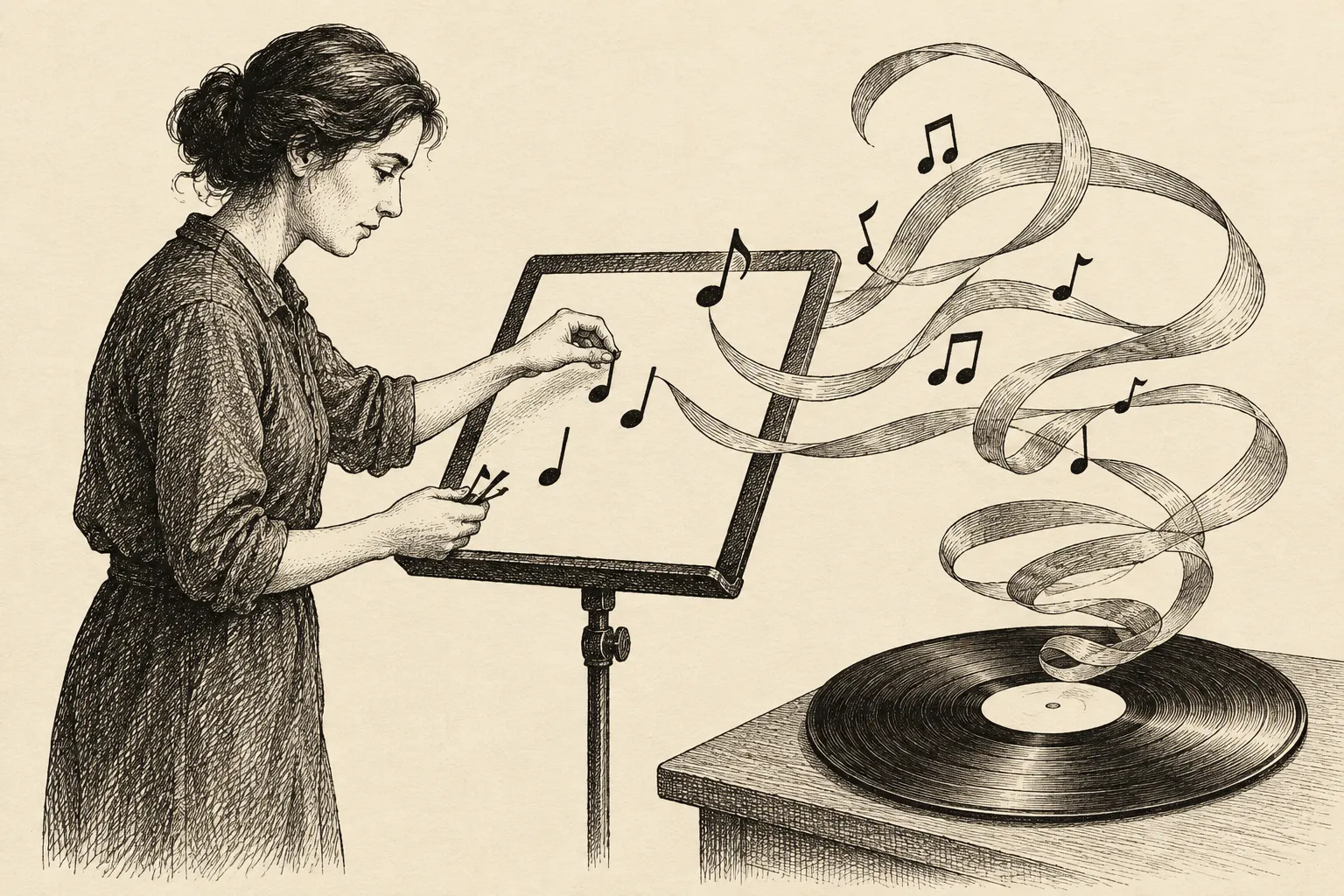
Can a song generator show its musical choices before turning them into sound? The authors built YuE2 to write a readable plan of melody and chords first. It then adds musical detail and produces a full recording from that plan. A person can change the plan, but YuE2…
3 paper · Original sources linked in every story
5 MINUTES ON PtoP
A generated song can sound finished while leaving you unsure how to change it. The authors of YuE2 are trying a different route: their system writes a readable plan of melody and chords before making a recording. A person can edit that plan and ask for another version. It makes the whole song again, rather than changing a few notes in the old audio, but the plan gives the person something concrete to work with. That idea—paying attention to what happens before the answer—runs through several of today’s items. See: An Editable Music Plan Can Guide a Generated Song
The middle step is not always something a person can edit. In Calpha, the authors send clues about a protein’s chain through a chat model to a specialist that predicts its shape. They report results for single chains and parts of proteins, but have not shown that written reasoning improves or steers a prediction. Another paper’s authors test a different kind of handoff: sending information from one word’s final processing layer into the next word’s input during training. They report savings under particular training conditions, not a general recipe for every language model. In both cases, how information moves matters, even when the route is less visible to a user. See: Calpha Routes Protein Clues Through Chat to Predict Shapes · Feedback May Stretch Language-Model Training Data When Data…
Context matters outside the model, too. Google DeepMind says AlphaGenome 2 predicts how DNA changes affect particular human cells, rather than relying only on results that group many cells together. DeepMind says this may reveal effects that grouping misses. It also says the tool is for research, not for identifying or treating a patient’s illness; its gut-disease example reproduced earlier findings on a computer, not in a laboratory. A more specific view could help researchers ask better questions, if it holds up in further work. See: AlphaGenome 2: Deciphering how cells read DNA to better…
For everyday work, the equivalent middle step might be less glamorous: knowing which records an AI task draws on and who gets to check the result. In a sponsored interview published by MIT Technology Review, leaders from SAP and Infosys argue that companies should connect their records, choose useful jobs and set clear rules while keeping people in control. Those are executives’ examples and views, not independent tests across companies. Still, they raise a useful distinction: an answer is easier to work with when its inputs and the places where a person can intervene are clear. See: Building AI that can work across the enterprise
This week, if you use AI to make or revise something, could you ask what information or plan sits between your request and the result—and which part you would want to change yourself?
Just here for the stories? They are below, by topic.
PtoP · NEWSLETTER
Six papers and the news, explained in plain English, each morning after the editor approves the issue. Free, and you can unsubscribe at any time.
News and analysis from the sources, separate from the papers. Headlines and dates link to the originals.
THIS ISSUE AT A GLANCE
 ↗02 / NEW / EDITOR PICKSFeedback May Stretch Language-Model Training Data When Data Is PlentifulWhen training text must be reused, should a model make another pass through it? The authors compare a…
 ↗03 / TOP VOTED · 6 MONTHSAn Editable Music Plan Can Guide a Generated SongCan a song generator show its musical choices before turning them into sound? The authors built YuE2 to…↗
PODCAST / ENGLISH EDITION
The front-page episode covers the papers and news; each paper also has its own short conversation.
Both voices are AI-generated with OpenAI. This is a scripted editorial conversation, not a recording of the authors.
Can a chat model help turn a protein’s sequence, its chain of building blocks, into a shape? The authors first use ESM2 to read that…
When training text must be reused, should a model make another pass through it? The authors compare a standard Transformer with a…
Can a song generator show its musical choices before turning them into sound? The authors built YuE2 to write a readable plan of…
FROM THE NEWS DESK
Editorial explanations of the sources: examples and possible uses are distinguished from what the source establishes.
Business and strategy MIT Technology Review · 16-11-2026 · company announcement
SAP and Infosys leaders argue companies need reliable records and clear rules before expanding AI. AI is software that handles tasks.
Imagine a store checking two sets of records before refunding a customer. An AI agent, software that can take steps toward a goal, could check both. If the records disagree, a person could review the case before money moves.
The examples and results come from executives in a sponsored interview, not independent testing across companies.
Their central point is simple: connect company records, pick useful jobs, and keep people in control.
MIT Technology Review published this sponsored interview in partnership with Infosys. The guests work for SAP and Infosys, which sell business software and services. They say many companies run pilot projects, or small trials, without connecting their records. They want companies to choose useful tasks, improve records, and set rules for access. Whether their reported gains will hold at other companies remains unclear.
A company could test an AI agent on bills, then check mistakes before giving it more work. It could also set governance, meaning rules and checks for what the software may do.
Was this explanation easy to understand?
People and society Google DeepMind · 11-11-2026 · updated 16-11-2026 · company announcement
Google DeepMind announced AlphaGenome 2, a tool that predicts how DNA changes affect particular human cells. DNA is the body's instruction code, and different cells read different parts of it. DeepMind says AlphaGenome 2 can spot effects that may be missed when many cells are grouped together.
Think of two cooks using the same recipe book but choosing different pages for their jobs. DeepMind reports that AlphaGenome 2 reproduced a known DNA link to gut disease in computer predictions. It connected a DNA change to gene activity in gut immune cells. A gene is a section of instructions. This was not confirmation from a new laboratory test.
DeepMind says the tool is for research, not for identifying or treating a patient's illness. Its gut-disease example reproduced earlier findings on a computer, rather than confirming them in a laboratory.
DeepMind says looking at specific cells may help researchers trace how DNA changes relate to disease.
DeepMind's earlier AlphaGenome tool predicted DNA effects across broad groups of body tissue. DeepMind says this approach made small differences between similar cells harder to spot. Scientists want to find DNA changes linked to disease and decide what to test next. AlphaGenome 2 instead predicts effects for a chosen cell type, meaning cells with a particular job. Whether its predictions will improve patient care remains unknown. It is not approved to identify illnesses.
Researchers could use the predictions to choose which DNA changes to test in cells. A variant is one such difference in DNA.
Was this explanation easy to understand?
ENGLISH EDITION / PAPER 01 · NEW / EDITOR PICKS
Why it matters to youA protein’s shape can offer clues about how it works. The authors show how a chat model could help predict that shape. They have not tested it in everyday use.
Can a chat model help turn a protein’s sequence, its chain of building blocks, into a shape? The authors first use ESM2 to read that sequence and supply clues about each block. Qwen3.5-9B, the chat model, receives those clues and passes information from inside its processing to SimpleFold. That specialist model then generates a shape when the chat model chooses a folding response.
Hypothetical illustration: A researcher enters one protein sequence and asks what shape it might take. Calpha could signal its structure head to generate a prediction instead of replying only in words. This illustration is not a tested research workflow.
The authors tested shape accuracy for single chains or isolated domains using backbone positions. A domain is a part of a protein, and the backbone is its main chain. They did not test full atom quality or protein complexes, which are groups of proteins. Their main accuracy test used one fixed request. They checked other wordings for whether they started shape generation, not for shape accuracy. The direct comparison also changed training choices, so it cannot isolate the effect of passing clues through chat. Related sequences affect some test groups. The authors assembled the CAMEO-style set themselves because the service was unavailable. Protein training also reduced accuracy on the subset of general questions the authors evaluated. This source is an arXiv preprint, a paper shared before formal publication. As a general PtoP note, preprint status does not establish peer review, or evaluation by other researchers.
Using one fixed folding request, the authors report a mean TM-score of 0.808 for final Calpha on FoldBench-334. That set was used during development. They report 0.635 for final Calpha on isolated CASP16 domains. A domain is a part of a protein. TM-score measures closeness to a known backbone shape; higher scores mean a closer match. The backbone is the protein’s main chain. In their direct ESM2-to-SimpleFold comparison, Calpha scored lower for chains of 300–600 building blocks across all three sets. For chains of 100–299 blocks, the reported uncertainty ranges include no difference. These ranges show which differences fit the test results; they do not establish equal accuracy.
Most chat systems and protein-shape predictors work separately. The authors show that Calpha can send clues through a chat model to a specialist shape generator. They do not show that this route makes the predictions more accurate.
The authors present single-chain shape prediction as the first step toward a broader system. They have not shown that written reasoning improves a prediction or changes its shape.
FROM PAPER TO PRACTICE
The official repository gives a local folding example, but this procedure has not been verified here. It requires Linux, Python 3.12, CUDA 12, and one graphics processor with about 48 GB of memory. Downloads and computing may carry costs; the required SimpleFold weights are licensed for research use only.
An n8n automation is not a useful starting point here: the documented example runs locally and needs substantial graphics hardware, with no tested n8n connection reported.
Was this explanation easy to understand?
ENGLISH EDITION / PAPER 02 · NEW / EDITOR PICKS
Why it matters to youTeams training language models may run short of useful text before computing power. Language models are programs that learn patterns in text. The authors test whether sharing information between words makes better use of that text.
When training text must be reused, should a model make another pass through it? The authors compare a standard Transformer with a version using latent feedback. A Transformer is a language model that processes words in layers. Latent feedback sends information from the final layer for one word into the next word’s input. They keep model size the same while changing the amount of unique data and the number of passes. Unique data means distinct training text.
Hypothetical example: imagine training on a limited collection of workplace manuals. One team rereads the same pages. Another shares each word’s learned context with the next word. The paper tests those training choices on its text collection, not on workplace manuals.
The authors test one model design and one fixed plan for training with feedback. They test sizes only up to 778M parameters. They say larger models, larger data budgets, or different designs may change when feedback starts saving computing work. Their grid of tests at 778M is incomplete. Predictions from the fitted law beyond that grid are not measured savings. The validation set excludes training documents but comes from the same processed text collection. The authors also remove training documents sharing a paragraph with the separate Paloma benchmark. A benchmark is a set of tests used to judge a model. PtoP note: this arXiv source is a preprint, a paper shared before formal publication. These training benchmarks are tests, not deployments in real settings.
Compute-saving comparison: at fixed model size and unique data, the authors report 44% to 48% savings. This range covers the 60M and 134M latent feedback models. They used 400 unique tokens per non-embedding parameter and a budget of two standard-Transformer epochs. A token is a piece of text, and an epoch is one pass through the training text. A parameter is a value the model adjusts during training. Non-embedding parameters exclude values used to turn tokens into the model’s initial word representations. The comparison asks how much computing each model needs to reach the same validation loss. Validation loss measures prediction errors on text kept out of training; lower is better. The reported range covers those settings. Data-saving comparison: at fixed model size and three epochs, the authors report 41% less unique data. This applies to the 271M latent feedback model starting from 100 unique tokens per non-embedding parameter. It needs less distinct text to reach the standard Transformer’s validation loss. Feedback still costs more training work per token. The authors also report a prediction check using their fitted law. A fitted law is a formula built from results to predict other results. Built using models from 60M to 271M parameters, it predicts losses for a partly evaluated 778M size. Its predictions are within 0.3% of those losses. This check is not a larger-scale training result.
The authors find that the better use of computing power depends on how much distinct text is available. Feedback costs more per training token. In their tests, models with feedback often need less total computing work when distinct text is plentiful. That matters when a team can afford more training but cannot easily collect more text.
The method could help teams choose how to train when they have substantial distinct text. It may be useful when they cannot easily obtain more. The authors compare models at a fixed size. Their fitted law predicts outcomes beyond the tested range; it does not measure them.
FROM PAPER TO PRACTICE
The official repository gives a research quickstart, not a verified low-cost reproduction. You need access to its code, uv, the stated Python environment, and substantial GPU resources; data access and running cost are not specified here.
An n8n workflow, which links routine software tasks, is not useful for reproducing this GPU-heavy training comparison.
Was this explanation easy to understand?
ENGLISH EDITION / PAPER 03 · TOP VOTED · 6 MONTHS
Why it matters to youChanging a generated song often means starting over without knowing what changed. The authors’ YuE2 system may let you revise its music plan before making a new recording.
Can a song generator show its musical choices before turning them into sound? The authors built YuE2 to write a readable plan of melody and chords first. It then adds musical detail and produces a full recording from that plan. A person can change the plan, but YuE2 makes a new recording rather than altering the old audio.
Hypothetically, a songwriter could ask for a gentle song, then change the chorus chords in its score. YuE2 would make a new recording from the revised score, not patch the first recording.
The authors say the small gap between the highest benchmark averages does not establish statistical significance. That means they cannot show the gap is unlikely to be due to chance. Their editing process makes the entire song again, even for a small change. Some tests had only partial coverage. The cover study’s Q3O style measure used an available-case subset, meaning only cases with available results. The authors also note that a chord model used for comparison had training data overlapping Chords1217. PtoP note: this arXiv source is a preprint, a paper shared before formal review. Benchmark results do not show that the system has been put to use.
On WildSongBench’s 192 prompts, the authors report a SongBench average of 6.7316 for standard YuE2. SongBench averages seven measures of song quality, including melody and vocals. YuE2 best-of-8 selects from eight possible songs. It reached 6.9632, the highest observed average in that comparison. In a separate listening test using the same saved model, experts favored songs made with a score more often than songs made without one.
The score gives people a place to inspect and revise musical choices before hearing the result. The authors tested whether that plan changes what listeners prefer. They also tested whether score edits appear in new recordings.
One possible use is comparing two song versions with different chords or melodies. The paper also examines covers made from a written version of a source recording, in a requested new style. These are possibilities for a user’s work, not uses tested in workplaces.
FROM PAPER TO PRACTICE
The official repository provides these steps; this procedure has not been independently tested here. You need Linux, Python 3.12, and a supported NVIDIA graphics card with 24 GB of video memory. Model files download on first use, so internet access is needed. The README says personal use is free; companies should contact the authors about a commercial model license.
An n8n workflow is not needed for this exercise; the repository’s example already saves the song and its score for human inspection.
Was this explanation easy to understand?
COMPARISON
Compare topics, possible uses and limits. Each result remains attributed to its own paper.
| Paper | Central idea | Possible use | Limit |
|---|---|---|---|
| Calpha Routes Protein Clues Through Chat to Predict Shapes | Can a chat model help turn a protein’s sequence, its chain of building blocks, into a shape? The authors first use ESM2 to read that sequence and supply clues about each… | The authors present single-chain shape prediction as the first step toward a broader system. They have not shown that written reasoning… | The authors tested shape accuracy for single chains or isolated domains using backbone positions. A domain is a part of a protein, and the… |
| Feedback May Stretch Language-Model Training Data When Data Is Plentiful | When training text must be reused, should a model make another pass through it? The authors compare a standard Transformer with a version using latent feedback. A… | The method could help teams choose how to train when they have substantial distinct text. It may be useful when they cannot easily obtain… | The authors test one model design and one fixed plan for training with feedback. They test sizes only up to 778M parameters. They say… |
| An Editable Music Plan Can Guide a Generated Song | Can a song generator show its musical choices before turning them into sound? The authors built YuE2 to write a readable plan of melody and chords first. It then adds… | One possible use is comparing two song versions with different chords or melodies. The paper also examines covers made from a written… | The authors say the small gap between the highest benchmark averages does not establish statistical significance. That means they cannot… |
ARCHIVE
The last two issues. Every earlier edition is in the archive.
16